

Lenovo Legion invited Explosion Network to check out their booth at PAX AUS this year, and so we headed over on Friday to see what they had on display. The booth showcased updates on emerging technology areas and featured exciting new laptops for gamers and developers alike.
As always with any tech booth, it was very busy with people bumper to bumper wanting to see what devices they can test drive, and at the centre of the booth was the Lenovo Legion 9i (18”, 10) which not only is, as you’d sort of expect at a gaming convention, a beast of a machine, but it also boast optional 2K 3D support. It was at the mention of getting hands-on with this device that my ears perked up, as 3D is a technology I’m not particularly fond of. Still, I certainly love to see it evolve and see how people continue to iterate on it over the years, across various devices and types of media.
The pitch for the device, or the ‘why 3D?‘ seems to be that it can help designers realise their work in a 3D space in front of them. And the first demo we were shown was a gear piece (maybe a car part? I’m not sure) building itself in a looped 3D video. Proof of concept for me: tick. Somehow, this magically 3D tech worked and looked very good.
One thing that has been a constant with 3D over the years is that it requires special glasses, or it can diminish the quality. Or, ultimately, it can feel gimmicky. Thankfully, the 3D on the Lenovo Legion 9i doesn’t require glasses, and running with a 2K max resolution in this mode, it looks good. The gimmick question is always open to debate.
When you sit in front of the laptop, it uses the built-in webcam to track your eyes, and that’s how the software is able to adjust the 3D image for you and tailor it so it works better for you, even as you may move side-to-side, playing a game, or watching a movie. In a convention setting, this did mean that, unfortunately, some people walking behind often would disrupt the software as it lost track of my eyes for a moment, but when that wasn’t happening, and it represented how you’d be using it in a more typical home scenario, it was really solid. I tried to test it by moving around and seeing if the image would drop out or if I would have a hard time with it, but I didn’t.
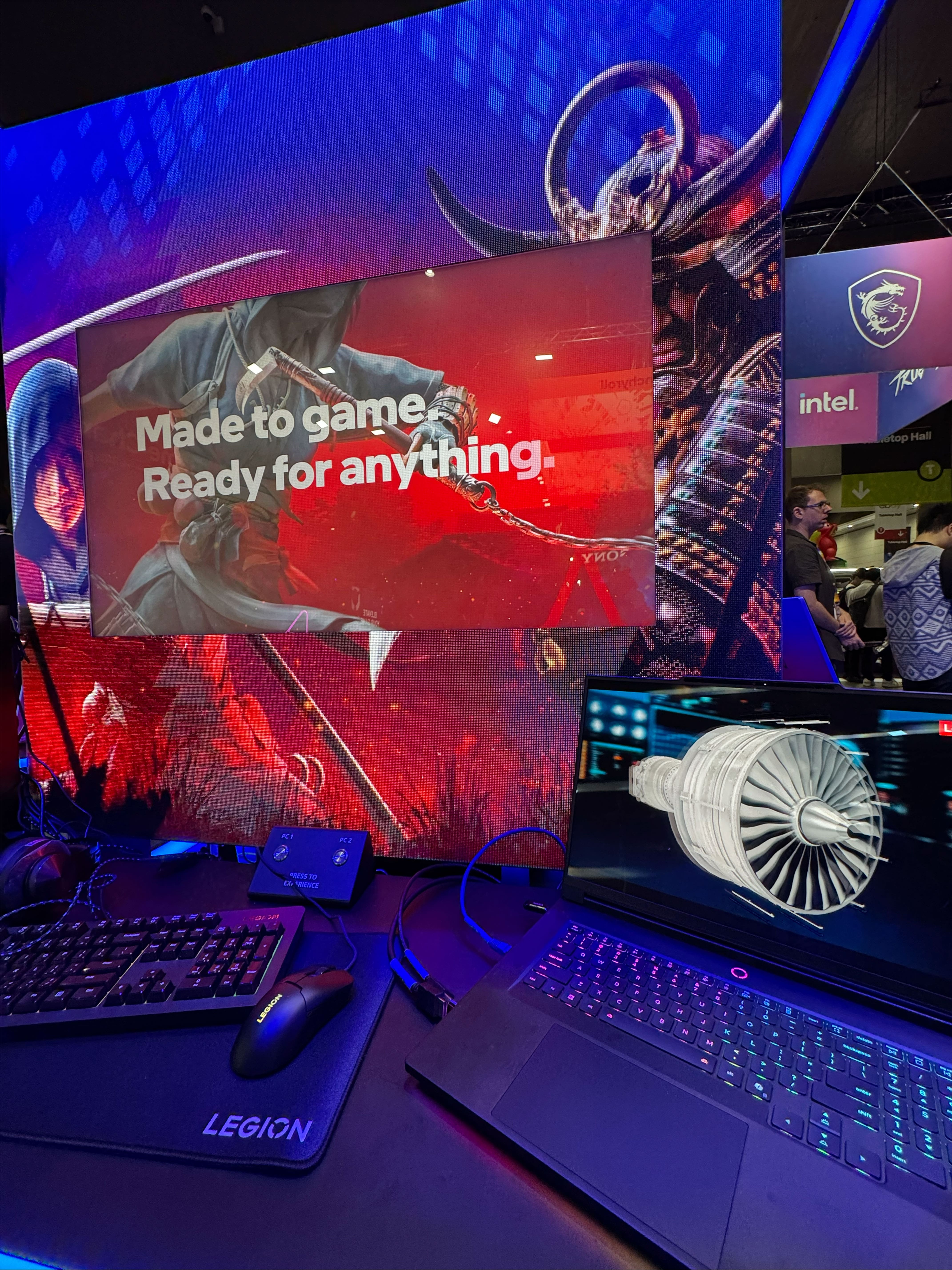
We got to jump into Cyberpunk 2077 and explore it in 3D, which felt very cool. I was most impressed by the image when driving around the desert location, as I think the 3D with the car in third-person offered a much deeper image that I really felt I could immerse myself in. Currently, 30 games have been tested and found to work with the built-in software, enabling 3D graphics in video games, while all 3D videos play smoothly.
The key question of: would I want to play a game like that fully in 3D? I would really need to test that to say for sure, but having played around for a short period, I was at least impressed with the technology on display.
This laptop isn’t all about 3D either, so I should mention another really cool, pun-intended, part of its build, which was the vapour thermal system. Considering how thin this machine is (93% screen-to-body ratio, according to the Lenovo fact sheet), it’s amazing that a vapour thermal system, with a vapour chamber, a hyper chamber, four fans, and dedicated fans for the memory, SSD, and Wi-Fi cards, is all within the machine.
A Lenovo representative mentioned that the Lenovo Legion 9i laptops are implementing Lenovo AI in some regards to help both change features on the go and optimise the laptop’s performance, without requiring you to think about which features to adjust or disable. Moreover, it appears that Lenovo are targeting designers and even game developers with its AI functionality, incorporating features designed to expedite the user experience. What exactly this means, I’m not too sure. The developers of Loftia were giving a talk at the booth on Saturday, which we unfortunately had to miss. However, it seems they’ve partnered up and are using Lenovo Legion 9i laptops for their development.
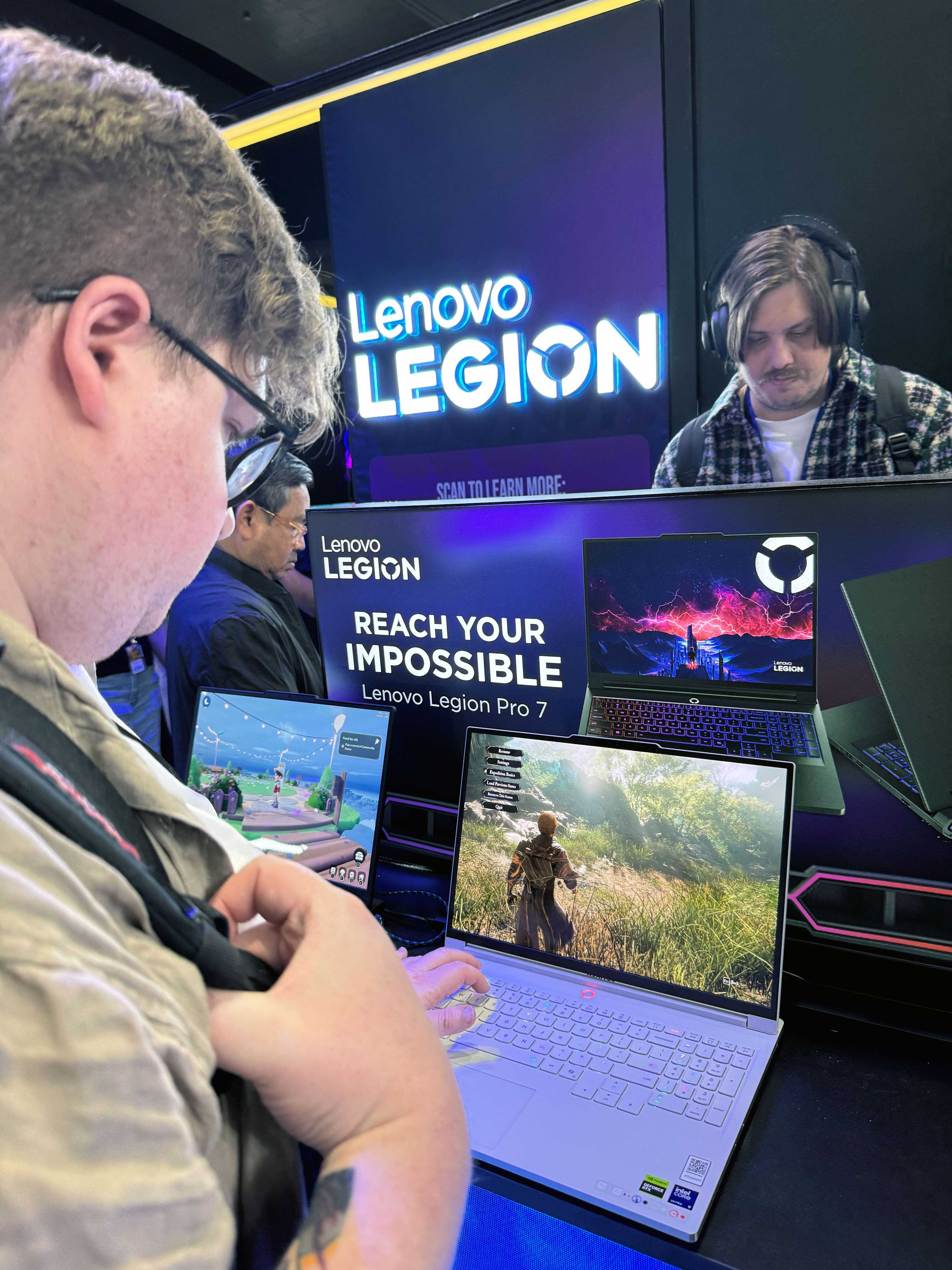
We took a look at some of the other laptops on display, but the Lenovo Legion 9i stood out for numerous reasons. The new Lenovo Legion Pro Series (Lenovo Legion Pro 7i (16”, 10) and Lenovo Legion Pro 5i (16”, 10)) both seemed like understandable upgrades over last year’s models I’d seen; they were thinner, quieter, and packed with the latest in Intel Core Ultra 9 chips. There was a wider range of laptops in this gaming focued area now, however, with the top end model clearly for the gamer who wants to set-up the laptop as their main gaming device at home, while some of the midde-to-lower speced models, like the Lenovo Legion Pro 5i seemed better for most consumers who may want to be able to play a FPS at home, and take it to class for some design work and coding in-between.
A couple of devices I managed to spend some time with were the Lenovo Legion Go S, which felt a lot more ergonomic than the earlier versions of handheld PCs I’ve played with, but still featured some of the same clunky display functionality I wished would be updated. I also paired the handheld with the Lenovo Legion Glasses 2, which were the first type of wearable virtual screens I’ve tried. I was surprised by how good the screen looked, how large it was, and even how bright the visuals were. It certainly wouldn’t replace gaming or watching movies on a proper screen, but in a world where these things were a lot cheaper, I’d happily wear these on aeroplanes.
Thank you to the Lenovo team for the tour of the booth this year and for providing a guided explanation of some of the new devices on display.
[Explosion Network attended PAX Australia 2025 with a provided Media Pass.]