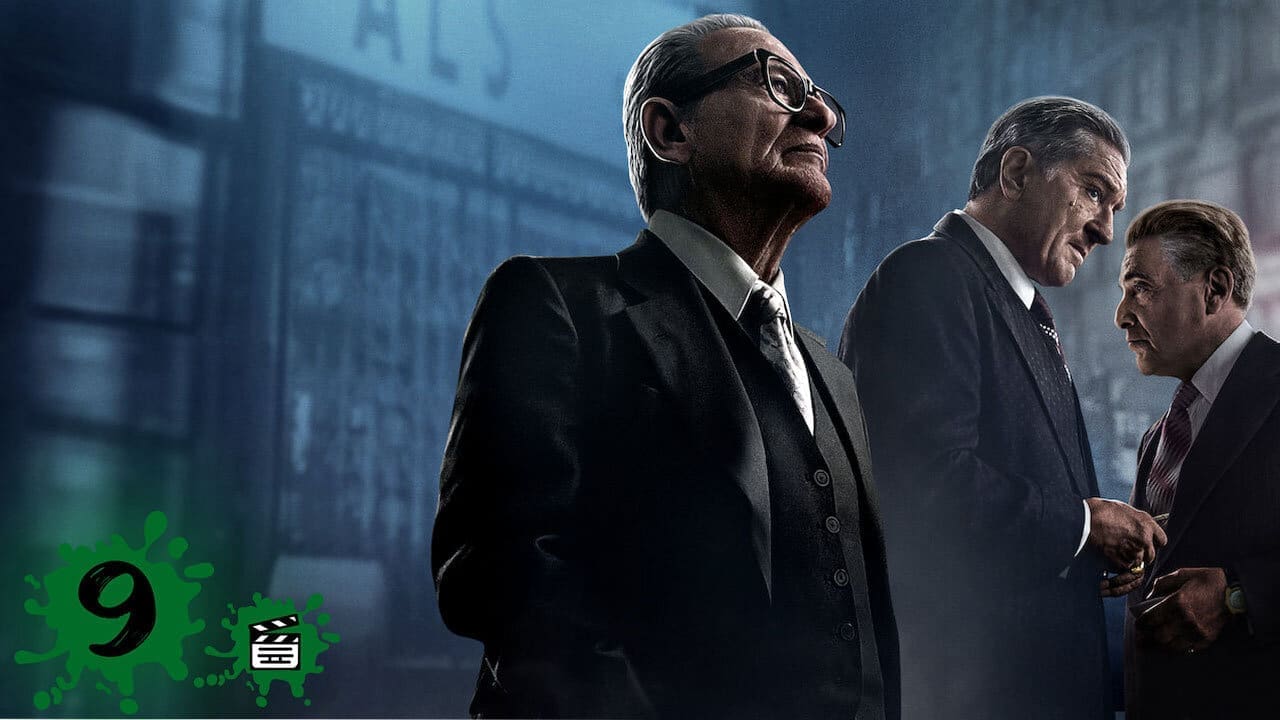

Synopsis: A mob hitman recalls his possible involvement with the slaying of Jimmy Hoffa.
Cast: Robert De Niro, Al Pacino, Joe Pesci, Anna Paquin, Jesse Plemons, Stephen Graham, Kathrine Narducci, Bobby Cannavale, Harvey Keitel, Ray Romano
Director: Martin Scorsese
Writers: Steven Zaillian (screenplay), Charles Brandt (based on the book I Hear You Paint Houses)
The opportunity to see Martin Scorsese collaborate with Robert De Niro and Joe Pesci again—along with the addition of Al Pacino, working with Scorsese for the first time—is enough to make any cinephile salivate. But in a world where Scorsese struggled to get the $170 million budget for the film, this certainly wasn’t mounted for monetary reasons. He’s also returned to the well here, and it’s fair to ask whether he has anything new to add to the genre he’s most associated with—the gangster film he helped define for many with his ’90s classic Goodfellas.
Near the end of the three-and-a-half-hour runtime, Robert De Niro delivers a line that encapsulates The Irishman and its core concern: “What kind of man would make that phone call?” The film asks, and attempts to answer: what kind of man is Frank Sheeran?
This is a character study at a more minute level than Scorsese’s other American-mafioso films, and it’s less flashy for it. While Henry Hill in Goodfellas was young, full of energy, and the film charted his sparkler erupting and fading, The Irishman explores Frank Sheeran, a man who doesn’t even get involved with the Mafia until he’s in his forties. The characters here are quieter, slower, calmer—for the most part—and not just because the actors are in their seventies. The film is slower-paced, and its length draws you into its world through often mundane conversations. If The Wolf of Wall Street was Scorsese showing up to the frat-house party, this is the cross-stitch he’s been working on at home for years.

De Niro, Pacino, and Pesci play their characters across decades thanks to a special camera rig and the work of ILM. It’s distracting the first time the film flashes back and a younger De Niro appears, but you move past it thanks to the tremendous performances. A few moments still stick out: an early scene shows De Niro’s apparent middle-aged character beating a man with the energy of a 70-year-old; and the eyes, colour-matched to real-life counterparts, don’t always convince. The de-aging mostly lands, though, and at worst is “good enough”—like a heavy makeup job that the actors then transcend.
It’s De Niro’s movie as Frank Sheeran, the mob hitman brought into the life by Russell Bufalino, played by Joe Pesci in a far more measured, restrained key than his other Scorsese roles. Sheeran’s a tough exterior—a veteran back from war looking to make his way like many were in the early ’50s—but he’s not chasing a party. He has a code, seemingly drilled into him in the Army, and it helps him know his place when he’s welcomed into the Bufalino crime family. He’s a working man at heart, which draws him to respect Jimmy Hoffa, President of the International Brotherhood of Teamsters, the biggest and first union of its kind. Hoffa is played by Al Pacino with an often scene-stealing performance; it’s simply the best he’s been in a decade.
In what will be a controversial decision for some, there is little to no female representation in The Irishman, even though Frank Sheeran’s family—especially his three daughters—are a big part of the story. The eldest, played by Anna Paquin in later years, utters only a handful of words, but they’re haunting when they arrive, and she’s a powerful presence for what she represents to Sheeran. Mob films and series like The Sopranos have often explored the two-sided coin of mob family versus home family, but The Irishman presents that relationship with a very dry reality. There’s no sympathy from me as the film closes on Sheeran.
The Irishman feels like Scorsese’s master conductor set—returning to what he knows so well to lead some of our greatest actors in one more towering movement. I hope it isn’t his last; he’s a phenomenal filmmaker. Either way, this will be considered one of his greatest hits when the curtain finally falls.