
Explosion Network may receive a commission when you purchase something via a link on our site
Synopsis: DREDGE is a single-player fishing adventure with a sinister undercurrent. Sell your catch, upgrade your boat, and dredge the depths for long-buried secrets. Explore a mysterious archipelago and discover why some things are best left forgotten.
Publisher: Team17
Reviewed on: PlayStation 5
Also available for: PlayStation 4, Xbox Series X|S, Xbox One, Nintendo Switch, PC
Developer: Black Salt Games
Producer: Nadia Thorne
Programmer/Writer: Joel Mason
Art Lead: Alex Ritchie
3D Art/Animation: Michael Bastiaens
Composer: David Mason
Additional Audio: Mikatte Music
Having sunk countless hours into Moonglow Bay and other slice-of-life games that featured fishing, like Stardew Valley or Cult of the Lamb, I knew Dredge would instantly be a “Buddy game”. Last year at PAX Australia, I played a brief demo, and although on paper a small open-world fishing RPG with cosmic-horror elements shouldn’t work, the gorgeous cel-shaded art style and darker tone of Dredge lured me in hook, line and sinker. Not only does it work, but Dredge’s genre-blending premise delivers an addictive open-world fishing sim complemented and enhanced by its Lovecraftian-inspired story, presenting a truly unique experience not found in other fishing games.
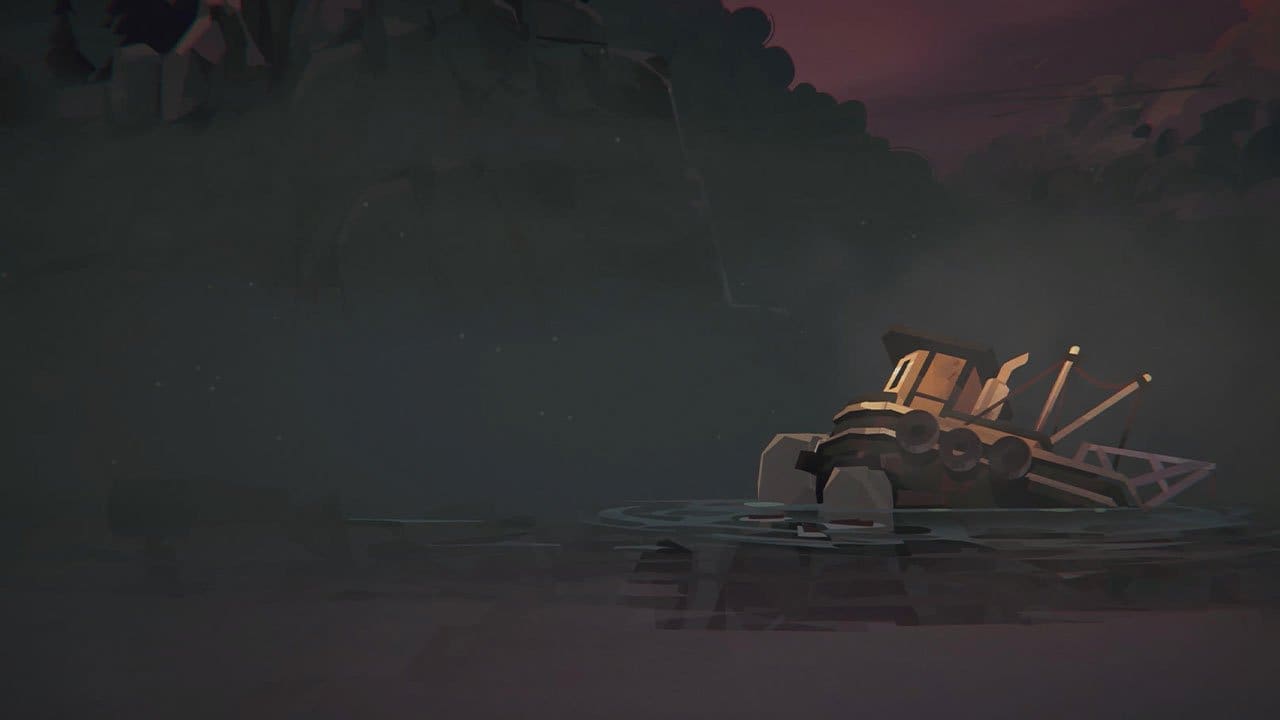
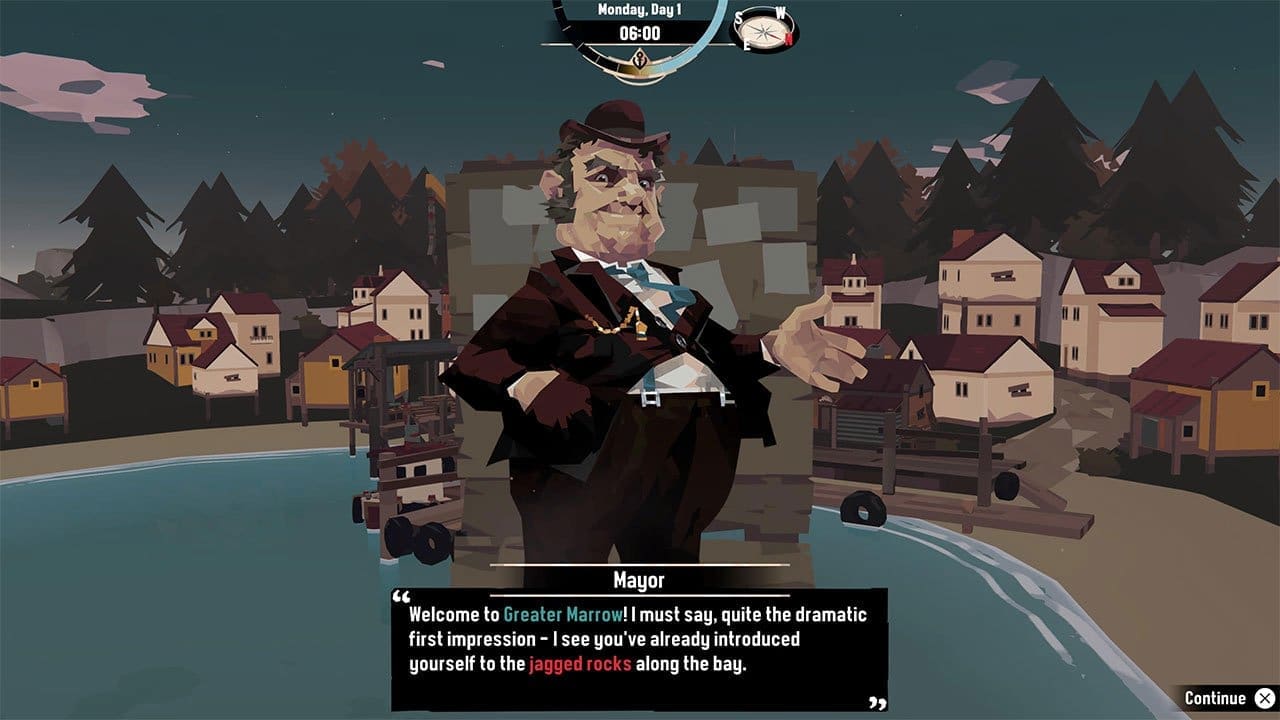
In Dredge, you play a grizzled fisherman answering a job listing for a town needing a new angler. On the way to the town, you are engulfed in fog and shipwrecked after smashing into jagged rocks along the bay. When you awake the next morning, you are greeted by the mayor of Greater Marrow. Despite a poor and, what I imagine, somewhat embarrassing first impression, the mayor loans you a new boat and, from there, you cast off into the smaller bay and ply your trade, with a small portion of your fishing hauls going towards paying off your loan; a small amount of interest going towards improving the town. Before venturing off, the mayor gives an ominous warning to make it back by sundown before the night fog rolls in. Soon after paying off your loan, a mysterious, reclusive man named The Collector, who lives in a ruined mansion on the nearby secluded Blackstone Isle, enlists your help. He is interested in dredging up five sentimental relics from a ship that sunk many years ago. Acting as the main story, if you find each of the items in the surrounding islands, he promises to reward you in ways beyond your imagination.
The key pillars of Dredge are selling your fish to upgrade your boat, dredging the seabed for valuable resources, exploring the dozens of islands in the surrounding archipelago and finding the hidden relics to discover the true secrets of the islands. Dredge’s exploration and core gameplay loop, emphasising time as a mechanic, is its biggest and most refreshing strength. Its small open-world design doesn’t inundate you with dozens of markers or flood your HUD with waypoints like the Ubisoft formula that has become stale and tiresome. Too many mindless markers can artificially bloat a game or hamper organic exploration and discovery, as seen in The Legend of Zelda: Breath of the Wild or Elden Ring. Outside of a quick and basic introduction, Dredge doesn’t hold your hand and allows you the freedom to roam at your leisure. Each new area feels distinctly different and requires different skill sets and equipment to succeed.
It’s within these moments the excellent score and audio design shine. Moments can go by where all you hear is the waves crashing and the sound of your engines humming as you glide across the open sea. Small piano notes are introduced in the most minimalist but effective and awe-inspiring ways—reminiscent of when Link wakes up and overlooks the Great Plateau for the first time. Quiet melodies and tempos fill the daytime whilst eerier notes underscore the stress and anxiety-induced night-time or painful story moments.

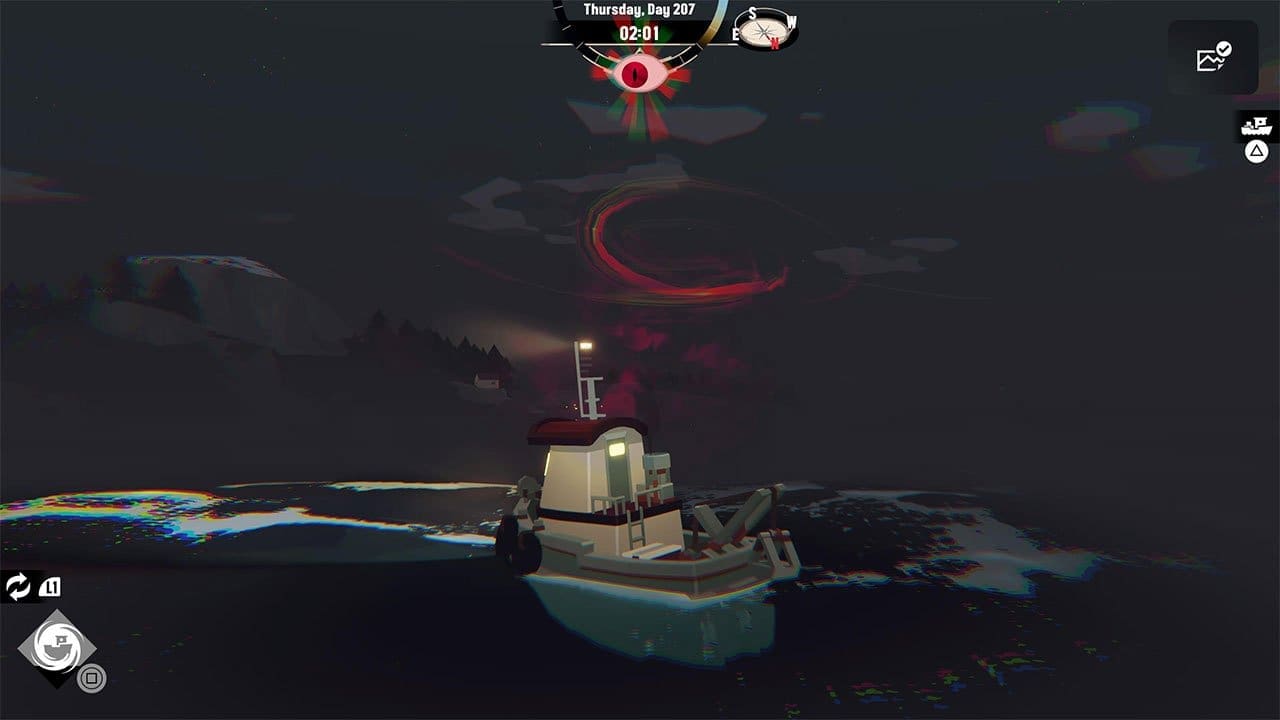
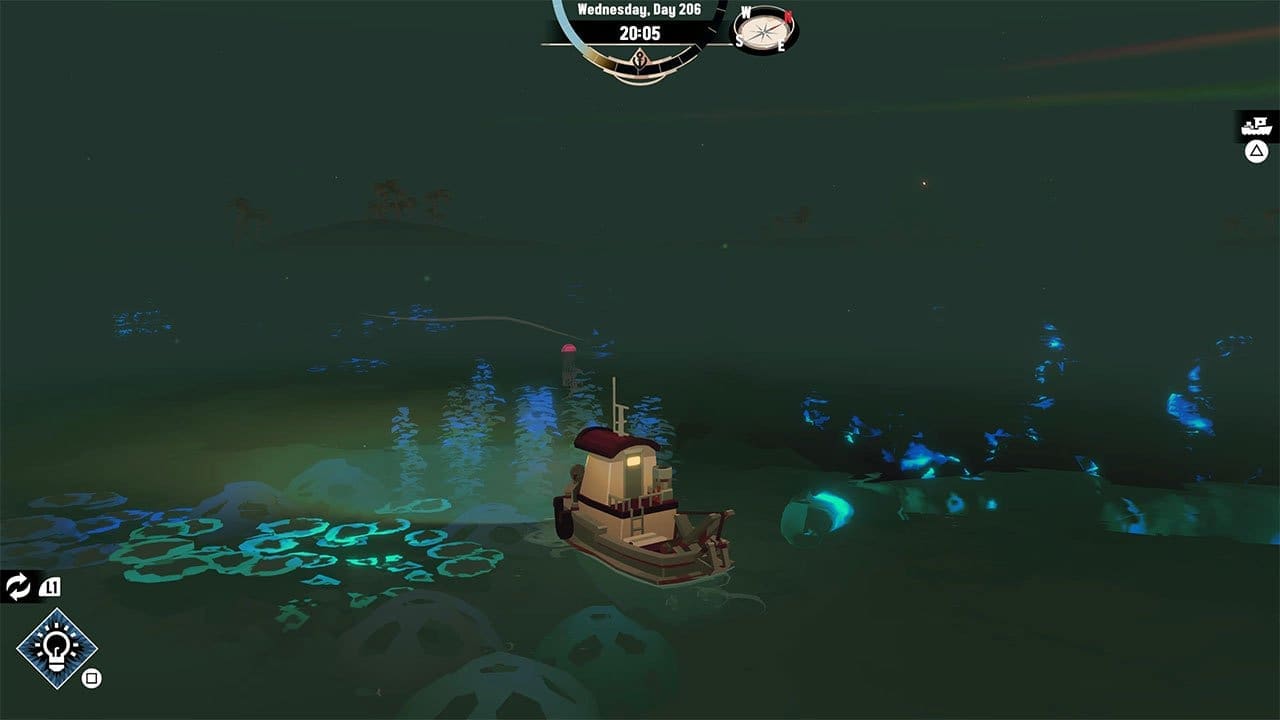
Travel and roaming use a risk-reward system, but at a cost. In Dredge, time and the panic meter are the two biggest factors. Time only progresses when moving, fishing or when you are docked and advancing time through sleep. Your first exposure to nightfall comes with a warning that night-time fog and other things increase your panic meter, and only bright lights will keep it at bay—or sleeping will reduce it. Once darkness descends and your panic meter starts filling, the near-perfect draw distance of the bright, vibrant pastel daylight world succumbs, and fog surrounds your boat. Visibility becomes low, cabin fever hits, and internal darkness takes over. Visions of dangerous rocks appear in front of you, ghost ships in the distance gun towards you, or massive Cthulhu-inspired tentacles lash out from under the surface. Everything you do in Dredge costs time, and you are always asking yourself: Can I afford it?
The payoff for after-dark activities is that certain fish that only come out at night are usually rarer, worth more, or you are more likely to catch various mutated versions of a species. Other rewards for venturing out in the sea of darkness and foggy unknown are finding cryptic prophetic rocks that unravel some of the world’s bizarre lore. Thankfully New Zealand-based developer Black Salt Games doesn’t force you out at night if you want to play a more conservative, peaceful experience. For the majority of my playthrough, I easily avoided the night with no risks of losing my precious cargo or damaging my boat. I generally stuck close to docks or waited until I had upgraded my vessel to the point of not fearing the night.
The fishing mini-game is simple and only requires one press of the same button when a moving slider is in the correct zone, indicated by a green or yellow bar. Depending on which rods you have equipped, it can require two to three consecutive button prompts. Each species of fish has its different type of mini-game, and in my entire playthrough, I found that fishing never got repetitive or became a chore. Although I was never really challenged, there is an excellent accessibility option you can turn on so that you never fail the mini-game. It may come in handy for the dredging mini-game, which is once again pressing one button at the right time but for a more extended period and faster challenge. There are specific spots where groups of each fish can be found, indicated by shadows under the water. An in-depth colour-coded encyclopedia gives you the shape, location, time of day, type of water and what type of equipment is needed to find and catch them. Completing the encyclopedia was a fun challenge and made easier with all the information provided and using the spyglass from your tool wheel. Identifying unknown species from a distance ensured I didn’t waste any precious travel time or get caught out at night. At one point, there was a focus on the consequences of depleting fish stock and the potential environmental impact, but nothing further eventuated. Maybe there was an underlying message I may have missed, but I would have loved to have seen this theme explored more.
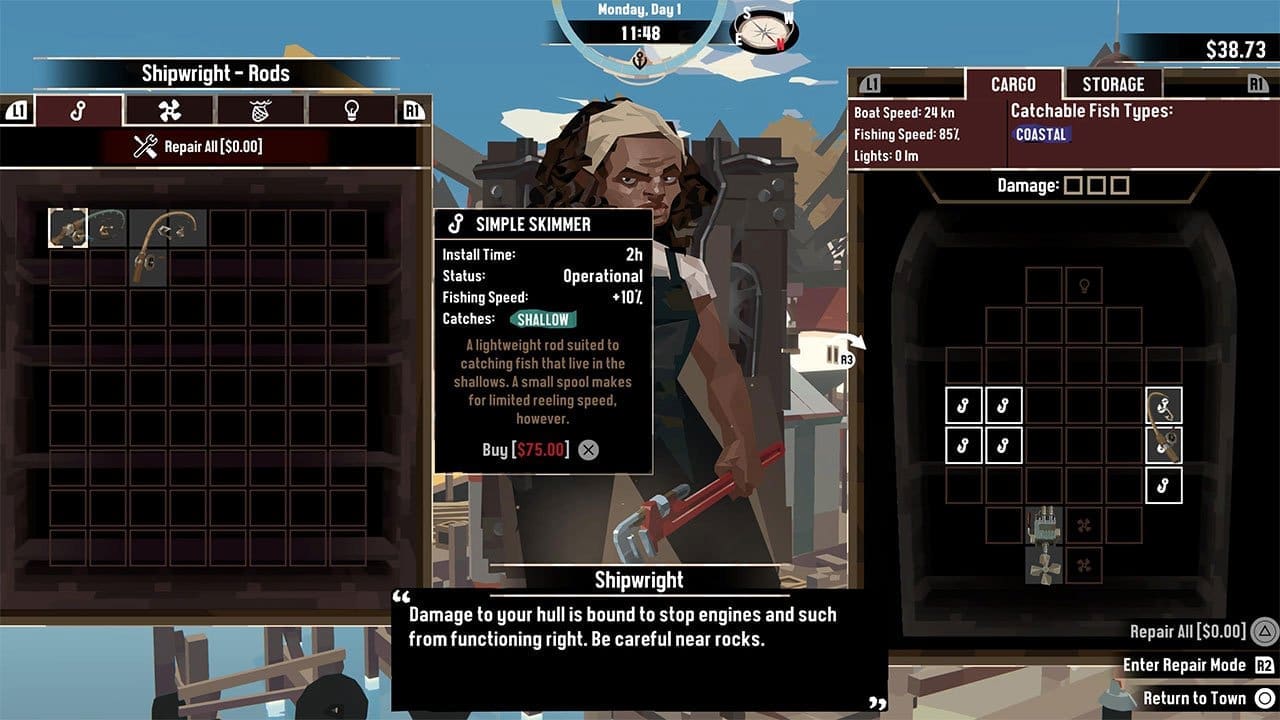
The other impressive design choice was the spatial grid-based inventory system. Comparable to Resident Evil 4’s attaché case, the cute Cargo system is shaped like a boat hull and has slightly more nuance, only allowing installed engines, rods, lights and trawlers to be placed in designated areas. Running into rocks or other things that go bump in the night can damage specific grids, effectively losing cargo in that slot or rendering items in that position useless until repaired. Combine this with storing your fish, relics or other items, and it’s a neat Tetris-like puzzle system that adds another fun element that never felt unbearable. A much bigger storage locker, accessible at each dock location, helped ease the burden of more extensive resources I couldn’t immediately use.
Even early on and playing it safe, I poured the majority of my time into completing side quests and finding research parts—which act like a skill tree—to upgrade equipment available from the shipwright. I also focused on selling fish and dredging the lumber, cloth and metal scraps found on several shipwrecks to upgrade my boat at the dry dock. Once docked, the shipwright, who can repair your damage and sell you new rods, engines and lights, can upgrade your vessel further, adding extra space, more attachment points for equipment and even superior hulls.
As I avoided night and barely used pots to catch fish, I spent a lot of my research points on my ship’s engine and rod development. With my fishing speed and boat speed increased, I felt slightly overpowered by the time I ventured out to find the last three or so relics. Although I found boat speed the most important asset, it gives different options for people who prefer to fish more passively through trawls and pots. Upgraded hull and engine slots did make exploration more rewarding and fun, knowing that I could catch every type of fish and my mobility was quite high.
The side quests and accompanying characters added to the islands’ atmosphere and mystique, from a weathered old lighthouse keeper who had seen it all to a grieving father looking for peace after his son was never found from a shipwreck. It all plays into a constant theme of grief and past trauma that haunt the islands and their inhabitants. Twelve collectable messages in a bottle scattered across the world detail a heartbreaking honeymoon voyage of a newlywed couple in the 1920s. These quests and seeing that story unravel and play out are worth the effort and only strengthen Dredge’s conclusion.
Even though I had high expectations, Dredge completely blew me out of the water. I expected a quaint fishing game, but it delivered so much more. Dredge successfully blends a Lovecraftian fishing-adventure RPG with a gorgeous, vibrant art design and a subtle and powerful piano-led score. The small open world encourages freedom and exploration, rivalling two of this generation’s biggest AAA games, The Legend of Zelda: Breath of the Wild and Elden Ring. The atmosphere and story themes are powerful, heartbreaking and enriched by the world’s past traumas and environment. I hope Dredge reels you in as it did me.