Synopsis:
To save her ailing father from serving in the Imperial Army, a fearless young woman disguises herself as a man to battle northern invaders in China.
Available now on Disney+ with Premier Access ($34.99). Available on Disney+ for all users 4 December 2020.
After being delayed by COVID-19 — and after being on the brink of releasing in cinemas — Disney’s latest in its line-up of live-action adaptations is finally available to watch. While the debate around Mulan’s Disney+ Premier Access release took up most of the attention recently, this film has been cautiously viewed by fans and critics since it was first announced. Fears of whitewashing were raised, and the news that none of the songs from the original 1998 film would be included — and that Mushu the dragon would not feature — was not well received. Even now there are calls to boycott the film for lead actress Liu Yifei’s support of Hong Kong police. Ultimately, the film is beautiful but has a hollow centre.
After northern invaders attack the Silk Road, the Emperor of China (Jet Li) decrees that one male from every family in the land will join the imperial army. For Mulan’s family, that means her elderly, injured father, Hua Zhou (Tzi Ma). Mulan decides to pretend to be her father’s son, stealing his armour and sword and joining the imperial army in his stead.

As someone who is not overly familiar with the animated film, I can’t comment too much on the changes between the two beyond those mentioned above. A number of characters from the original have been condensed, changed, or split. Mulan’s grandmother is no longer needed, with her duties given to Hua Zhou, while Li Shang has been replaced by the duo of Commander Tung (Donnie Yen) — Mulan’s mentor and a leader in the imperial army — and Chen Honghui (Yoson An), a fellow recruit and Mulan’s love interest. Even the villains have been changed, with Jason Scott Lee as Bori Khan, the leader of the invaders, instead of Shan Yu; and powerful witch Xian Lang (Gong Li) replacing Shan Yu’s falcon, Hayabusa.
The plot hits most of the key moments from the original, adjusting a few pieces here and there. It does feel oddly paced, with certain elements feeling rushed. The movie hammers its themes and lessons, hand-holding you throughout. For a Disney movie, it’s very low on comic relief or fun in general. There are a few laughs with the other recruits and with Mulan’s sister at the start, but this is, for the most part, a serious affair — which raises the question: who is the target audience for this film?
The film isn’t helped by an amazing lack of character. There are almost no three-dimensional characters to find here. Mulan is fine, but we barely get to know her at all due to her pretending to be a man for a large portion of the film. Not having someone to share her secret with (like Mushu in the animated film) means we never learn how she is feeling or what she is thinking. Liu Yifei is physically impressive in the role but isn’t given a chance to really show her range. The villains are incredibly stereotypical from the little we get of them, and the connection the film tries to make between Mulan and Xian Lang feels forced. The relationship between Mulan and Chen Honghui is one of the few handled subtly, but it could have used more investment.
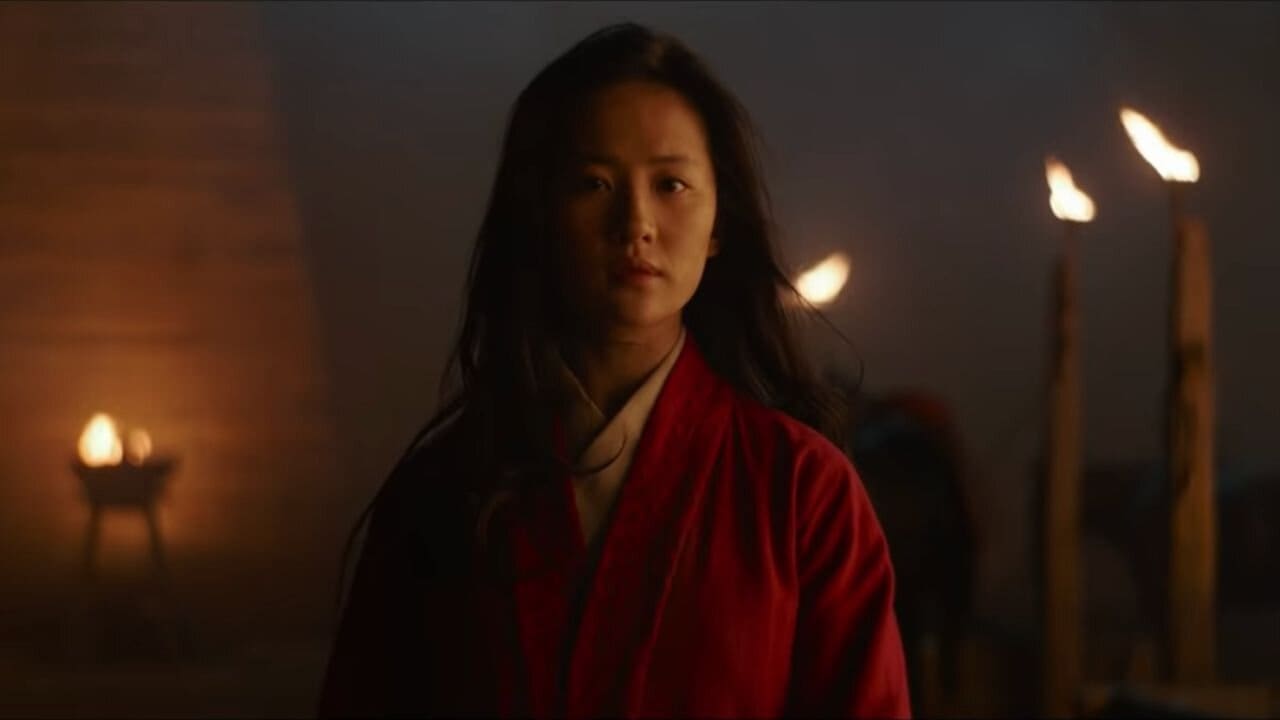
While the script may not have been the focus, the production is where Disney seems to have thrown its money. The scenery is beautiful, the costumes are great, and the scale is impressive. While not historically or culturally 100% accurate, it will work for most viewers as long as you remember this is a fictitious version of China — just like Aladdin’s Agrabah.
The action sequences pay homage to Asian cinema war epics, with Crouching Tiger, Hidden Dragon a likely influence. The film introduces (poorly) the concept of qi, “the boundless energy of life itself,” which Mulan is strong in and which allows her to perform gravity-defying moves. It is never really explored or explained in great detail, and Mulan seems to be the only Chinese soldier to possess it, which leads to a couple of visually interesting moments.
With Mulan, Disney has tried to provide a version of the Chinese folklore that’s more respectful. Unfortunately, in doing so, they remove a lot of the fun and character from the animated source material, leaving only a series of pretty shots more focused on telling a parable than on telling a fun story.