
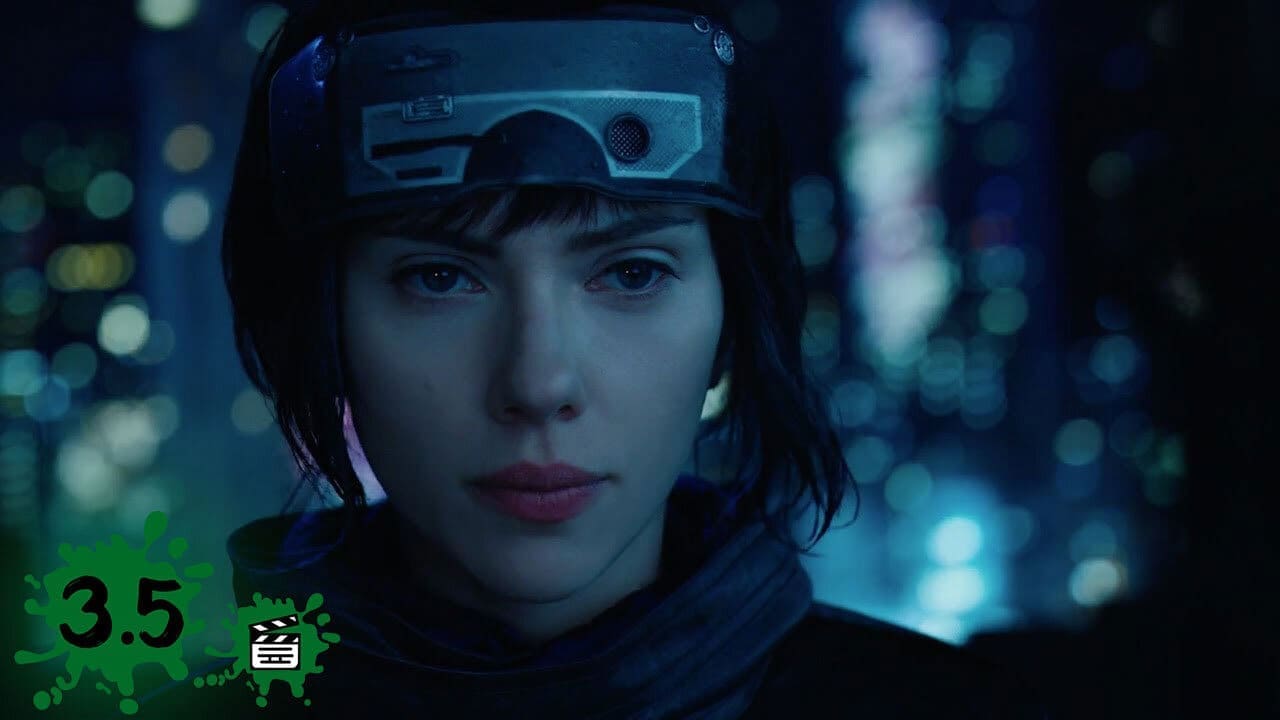
In 1995, Ghost in the Shell directed by Mamoru Oshii and based on the manga by Shirow Masamune was released, and since then it has become a cult anime classic. When I watched the film as a kid, I found it boring — its deeper questions about life, identity, and what makes us human were lost on me. Similarly, that same year I watched Ridley Scott’s Blade Runner, which I also found to be boring at the time. Both films featured action and rich sci-fi worlds, but they challenged audiences with deeper themes. The 2017 live-action Ghost in the Shell, however, does none of these things. It’s boring for all the wrong reasons.
Scarlett Johansson plays Mira, a woman saved after a terrorist attack whose brain is implanted into a cybernetic body. Created to be the first of her kind by the powerful Hanka Corporation, Mira becomes Major and is assigned to Section 9, a counter-terrorism bureau. Her purpose is to prove the success of this new technology. However, she soon encounters Kuze, a hacker killing across the city who forces her to question everything she thought she knew about herself.
Mira remembers little about her past — her memories are mostly gone. Her partner Batou tries to connect with her, showing genuine care, but Mira increasingly seems detached, leaning into her robotic side.
The story in Ghost in the Shell isn’t terrible, just overly simple. It could have served as a springboard for a new franchise, but instead the film constantly undercuts itself. Where the original anime trusted its audience, this adaptation explains every detail to the viewer as if they can’t keep up. Characters awkwardly narrate exposition, stripping away any sense of mystery. Ultimately, the movie boils down to a clichéd “she’s lost her memory” trope as Mira searches for her past.
Johansson gives her all, delivering a strong physical performance to embody Major’s stoic presence and combat skills. Yet her version of Mira feels lifeless — not as a reflection of her cyborg nature, but as a result of uninspired writing. By contrast, Pilou Asbæk’s Batou stands out as the only character who feels human. His compassion, love of stray dogs, and loyalty to Major bring a spark of authenticity, and his performance captures the spirit of the original anime perfectly.
Juliette Binoche and Peter Ferdinando, on the other hand, seem to think they’re in a low-budget sci-fi B-movie. Their lackluster performances clash with Johansson’s serious commitment to the role. It’s a shame, because you can see Johansson trying to build a character she could continue to explore in sequels.
Where the film does succeed is in its world-building. Neo-Tokyo looks incredible, filled with dazzling visuals and CGI that bring the futuristic setting to life. Clint Mansell’s score, mixed with reimagined tracks from the anime, perfectly captures the right mood. Rupert Sanders directs with style, delivering a glossy homage that looks and sounds like Ghost in the Shell, but beneath the surface there’s nothing of substance.
Ghost in the Shell (2017) is all shell and no ghost. It has plenty of eye candy, but the soul of the story and its characters are missing.
Rating: 3.5/10


![[MIFF 2021] – The Hill Where Lionesses Roar Review](https://b3313143.smushcdn.com/3313143/wp-content/uploads/2021/08/The-Hill-Where-Lionesses-Road-Review-Thumbnail.jpg?lossy=2&strip=1&webp=1)