


Pokémon Quest Review (Nintendo Switch & iOS)
by Dylan Blight
Synopsis
Welcome to Tumblecube Island! This strange new land is the setting for Pokémon Quest, a rambunctious action RPG for Nintendo Switch and mobile devices. Pokémon Quest is created by GAME FREAK inc., the original developer of the beloved Pokémon RPG titles.
Announced during a conference held by The Pokémon Company on May 30, Pokémon Quest was released later the same day on Nintendo Switch and in late June on mobile devices. The two versions cannot share save data or transfer of any sort, which is highly unfortunate.
Pokémon Quest has a unique art style for the franchise as you travel to Tumblecube Island. If you didn’t guess it — everything is cube-styled, with the go-to comparison being Minecraft. It’s cute for the most part, particularly on some of the smaller Pokémon that look adorable as little cube blocks.
In Pokémon Quest your character travels to Tumblecube Island to— look, I have no idea. Whatever thin story exists in Quest is solely to have you put together a team of Pokémon and clear out the levels, eventually reaching the final boss who’s held up on a mysterious small island at the end of the story. Who’s this mysterious villain?! Well, Quest only features the 151 Pokémon from the original Kanto region, so take a wild guess and you’re most likely correct.
For each mission you can take a team of three Pokémon; each can have up to two attack moves and be equipped with special stones to add more health, attack power, shorter move cooldowns and more. Your team will navigate automatically and auto-attack the closest enemy. If you turn on “auto mode” your Pokémon will also trigger their attacks themselves. With auto-mode off, it’s up to you to tap on-screen to use moves, each with a different recharge time. Early on, you can turn on auto mode and return to a “mission complete” screen. Late game, however, it can be different, especially on some boss levels — your Pokémon won’t be smart enough to use the right moves at the right times. If you have a powerful attack with an 8–10 second recharge you don’t want to waste it on an enemy that’s one auto-attack from fainting; better to save it for the boss about to appear.
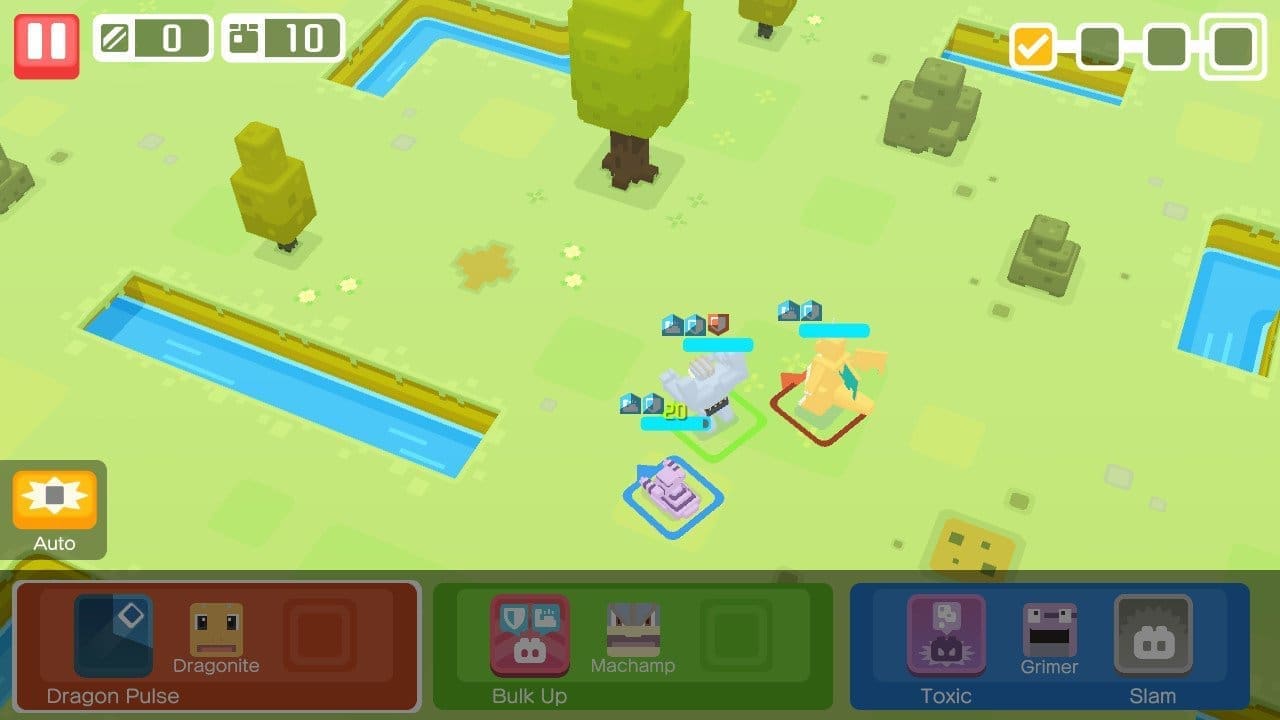
When playing in auto mode the difference between mobile and Switch is negligible. However, when you need to be tapping attack buttons, mobile is better simply for the ease of handheld play compared to a Switch (especially docked, where you’re using a cursor). I’d suggest mobile overall for this reason alone.
Pokémon Quest uses a turn-based battery system which limits session length. Your battery starts with a max of four charges, allowing four missions before you wait thirty minutes for a recharge. Love-it-or-hate-it, but Quest doesn’t ask for money to recharge your battery. You can spend in-game currency (earned daily and from milestones) to recharge it, but you can’t rack up real-life dollars just to keep playing.
The max you need to spend on Pokémon Quest is $45 AUD, which buys all the extras you’ll need, and it’s nice the game doesn’t let you pay for extra recharges or easy power boosts. Each of the three packages comes with a small bonus of in-game currency — once-off; you can’t rebuy them even if you wanted to. If you think you’ll buy the extras, do it early — it makes the experience less grindy. I didn’t buy them until the last level and the game was a huge grind at points.
You get new Pokémon by cooking special dishes at your base. Different ingredient combinations you pick up during quests attract different types. The system is convoluted and the game doesn’t teach you how to attract specific Pokémon. You’ll be searching for guides — I ended up keeping a list of recipes on my phone. Worse, after you discover, say, how to attract Bug-type Pokémon, there’s no in-game recipe memory — you must remember the exact combination of ten ingredients.
Extra Pokémon can be used two ways: train a favourite by sacrificing others as fodder to level faster, or sacrifice to change a Pokémon’s move — but the new move is random, meaning you can roll something worse. If you’re chasing top-tier moves (e.g., Alakazam with Psychic), the RNG can be a pain as you feed Pokémon after Pokémon to the gods.
Once you complete the main story, your quest — as is mine at the time of writing — will be to complete your Pokédex. Of course, you gotta catch ’em all. Doing so requires grind, RNG and patience. You can grind high-level caves for ingredients; higher levels include ingredients to attract legendary Pokémon — Mewtwo, Articuno, Zapdos, Moltres and Mew. To reach those levels you’ll need a strong team, but the game doesn’t allow much variation in what makes one. Certain Pokémon and moves currently carry, which, if you follow, makes the game boring and not open to experimentation. Me personally: shiny dream team; I don’t care if I’m sacrificing power for style points.
Pokémon Quest’s longevity depends on whether you want to complete your Pokédex or toss to the RNG gods for shiny hunts. There’s no need to metagame move lists and team comps outside the ease of auto-running the highest levels, with no PvP mode present. Quest is cute fun though, and clearing batteries over breakfast or while watching TV can quickly become routine. If you’re like me, the hunt for a complete Pokédex and the excitement of even the worst shiny keeps Pokémon Quest around for some time.

Developer: Game Freak
Publishers: Nintendo; The Pokémon Company
Platforms: Nintendo Switch (reviewed), iOS (reviewed), Android