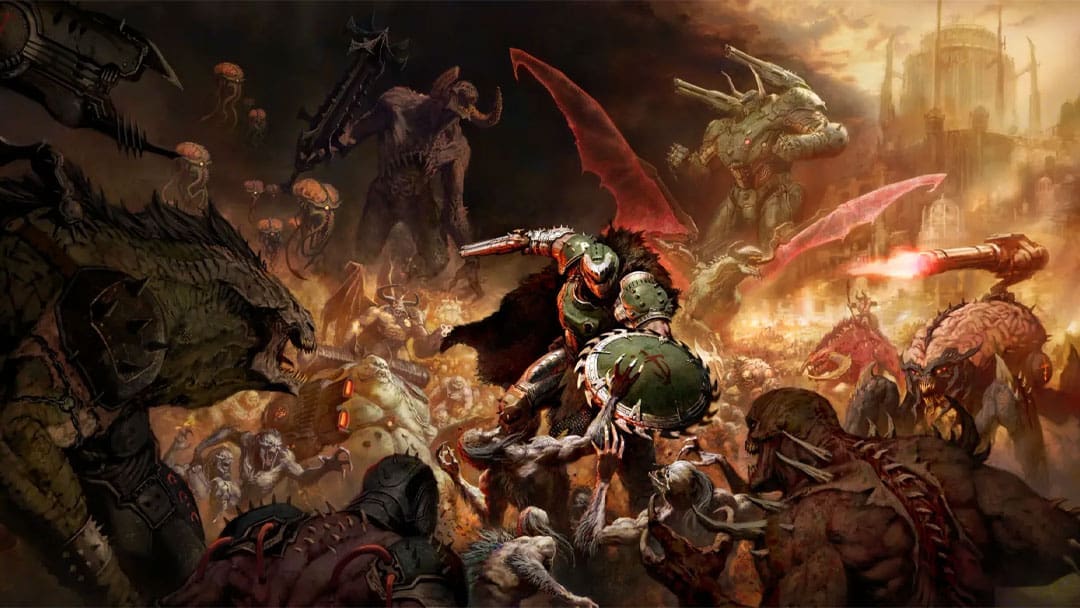
Daddy Doom has a razor-sharp shield now.
Doom Slayer has a shield and a badass coat as he battles against the forces of hell, in a prequel to Doom (2016) and Doom Eternal. If the gameplay trajectory of those two games took the Doom Slayer into the sky, as he got a grapple and begun flinging himself around in acrobatic ways in the battlefield, Doom: The Dark Ages is a firm plant in the ground; Doom Slayer is a tank, and will stand his ground with shield at the ready in the face of the demon hordes.
The world in Doom: The Dark Ages is a “techno-medieval” setting, which is to say people have iron-clad armour, leather armour, and shields, but there’s also big-ass guns and towering robotic mechs. For players and the Doom Slayer, the most crucial change between this game and the previous two is the shield, a weapon that you’d be mistaken to think would slow down the gameplay. As enemies spray out projectiles or attack the Doom Slayer, you’ll see green either on their attacks or the projectiles themselves, meaning you can counter these, opening up a melee for a response from your Super Shoutgun or sending a projectile flying back at the enemy that shot it at you. You’re not cowering behind the shield; you’re always using it to push forward.
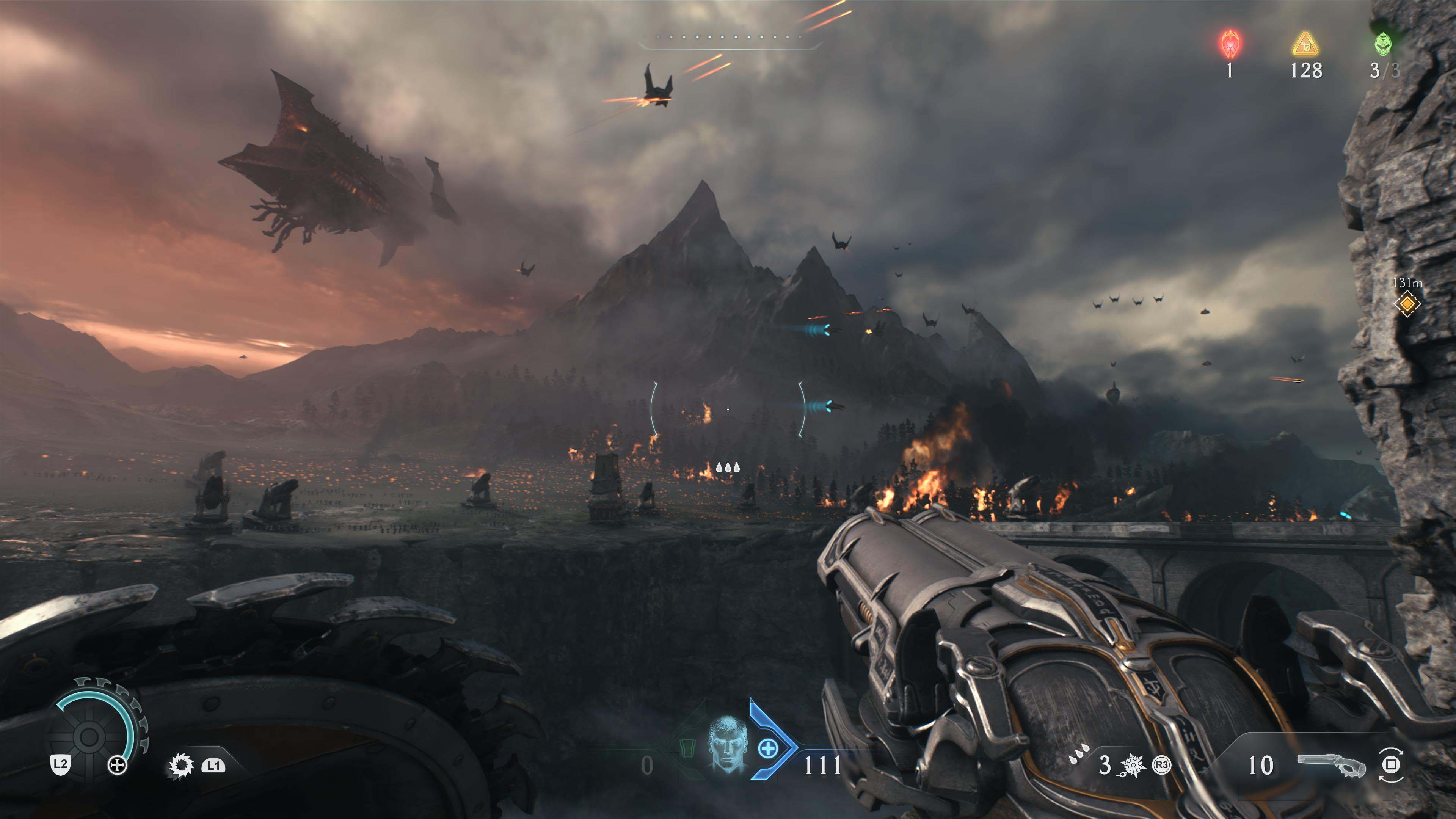
Suppose there are two Mancubus at the back of the battlefield, you’re not waiting for them to come to you. In that case, you’re sending your shield flying into the pack of Zombies in front of you, recalling it to counter one of green projectiles in front of you, swerving in and out of the other red projectiles all around you, while blasting the demon hordes around you, all before sending yourself flying toward the demon in front of you and wailing into it with a Flail, ripping and tearing its flesh to pieces, as it drops ammunation and health.
As you cross each battlefield as the Doom Slayer, your footsteps leave a thud at each imprint. He is a walking tank, the roaring killing machine that’s approaching silently, but instead with the acoustics of an army within one man. Leaping from a cliff-face, the Doom Slayer lands with thunder, a shockwave hurtling around and damaging enemies. With an arsenal of new weapons, including one that sprays enemies with skulls, and a surprising twist of the BFG, this is another Doom game that enables you to feel like the ultimate bad-ass.
Along with the combat changes, which give Doom: The Dark Ages a more grounded battlefield than the previous two entries, id Software has also introduced two new level designs that see the Doom Slayer riding in either a mech or on top of a dragon. The mech levels, or called here ‘Atlan Mechs,’ are usually preety short, and a nice way to refresh the pacing between the game’s core levels. Across the 22 in the game, I piloted the mech around 3-4 times. You’ll duel demons in first-fights mostly, but there’s not much to these mechanically.
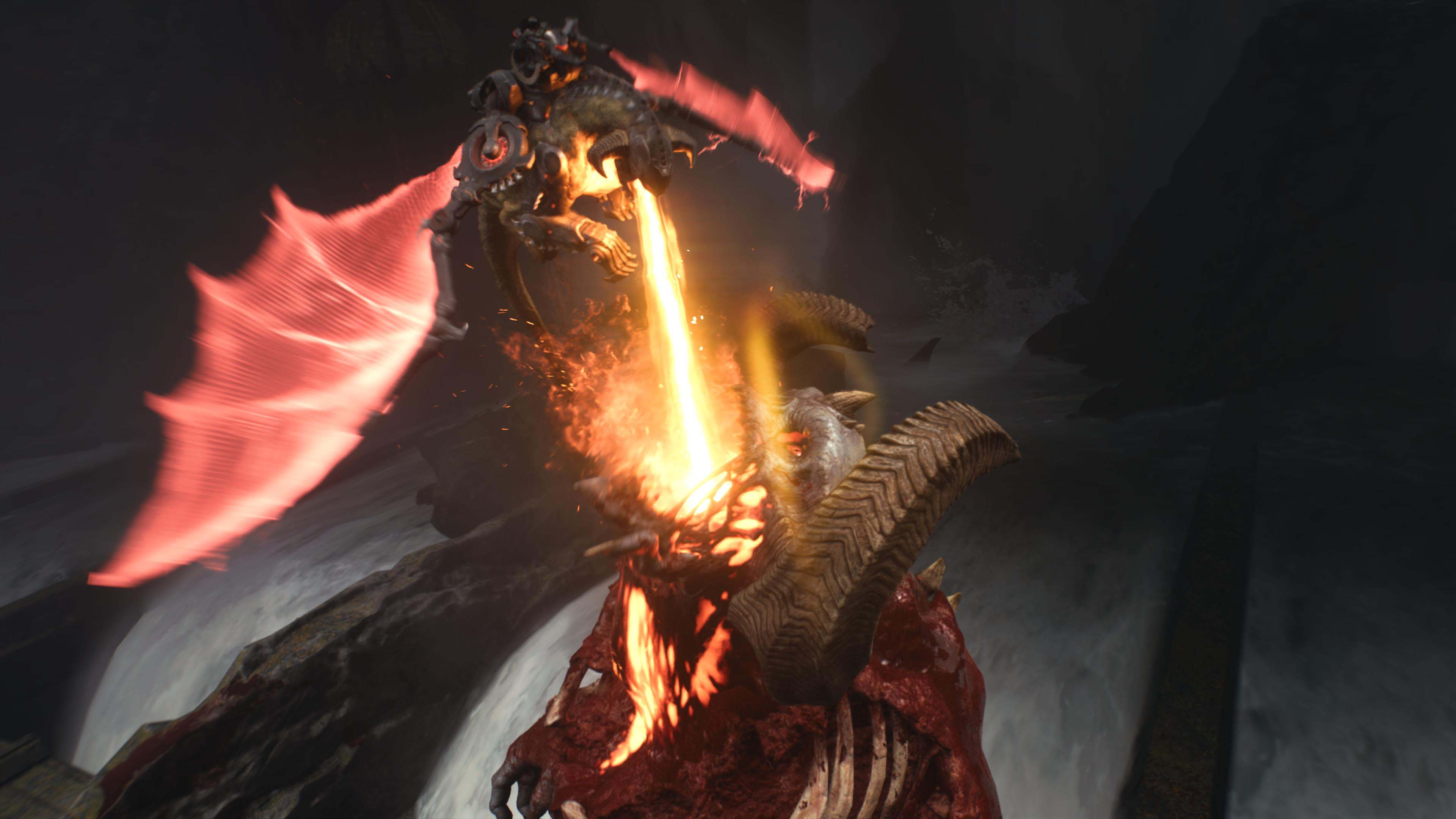
The cybernetic dragon, however, is a bit more interesting as the levels that include this beast, which is part of the Doom Slayers team, feature a mix of core gameplay and dragon fights. You’ll usually be using the dragon to take out turrets, on a ship, and then its engine before landing, where it crashes and takes on foot as the Doom Slayer to destroy something from within. You can also do some optional chases on the dragon to get gold that you can use to upgrade the Doom Slayers’ gear. The dragon levels aren’t bad, but unlike the mech ones that felt short enough, I didn’t need more, or feel like they could have done more. The dragon levels are full-length. Id Software missed an opportunity to expand here, as I never truly felt like I was a bad-ass on the back of this thing, as bad-ass as it may look.
Level design has always changed into a more open approach. Open plains now feature optional areas to explore, where secrets await those willing to go off the beaten path, and plenty of extra combat encounters that can prove more challenging than following the main path. I was happy to spend the extra time finding the Secret Key in each level, discovering ways to upgrade my arsenal, improving my shield, and using melee attacks. It took me 14 hours to beat Doom: The Dark Ages, though I’m sure you could do it a lot quicker if you weren’t looking for as many of the extras as I was during my playthrough.
For those who loved diving into the codex logs in previous games to unravel more of the lore and the Doom Slayers’ background, there’s more story here than ever. Each level has one or two cutscenes, and distinct ‘bad guy’ and ‘good guy’ characters interact with the Doom Slayer throughout the campaign. I could recount a brief version of the plot if needed. With all of that said, I still didn’t care. And I’m not even negatively saying this. The number of cutscenes here has increased significantly over the past games. Yet, they’re still basic-enough, and short-enough that most players will watch them for contectulasation reasons, even if you’re like me, and the basis of ‘you’re Doom Guy and there’s a shit-ton of demons over here to kill’ being more than enough.
I haven’t even mentioned the music, which, in short, is Finishing Move’s disappointing attempt to capture the iconic sound created by Mick Gordon for Doom and Doom Eternal. It does the job of supplying a heavy metal backing to the game. There’s no memorable tracks here, or moments I felt the music truely engadged my core muscles as I tensed up during gameplay and music kicking-my ass concurently as in the past two games.
(Review code provided to Explosion Network.
Read about our review and ethics policy here.)