Synopsis:
The Red Lantern is a resource-management narrative game where you and your team of five sled dogs must survive the wilderness and find your way home. You play as the Musher as she sets out to build her dog-sledding team and her new life.
Publisher: Timberline Studio
Reviewed on: PC
Also available for: Xbox One, Nintendo Switch
Cast: Ashly Burch
Developer: Timberline Studio
Game Director, Writer: Lindsey Rostal
Tech Director, Tech Artist: Nathan Fulton
Lead Artist: John Juarez
The Red Lantern is an interesting rogue-like that combines survival elements with resource management to tell a story of adversity and overcoming life’s challenges. The game begins with a young woman driving en route to the Alaskan bush and, along the way, picking four pups to add to her sled-dog team. Chomper already sits alongside her in the van: a city-bred husky, but still eager to begin this new adventure. The unnamed musher you play as tells the dog that they’re starting a new life out here. The city life and doctor job didn’t turn out so well in San Francisco, but she’s always dreamed of dog-sledding, so she’s out here to prove she can do it — and to make a childhood dream come true.
There are eight stops on the drive into the bush where you pick which pups to add to your team. You only need four, so you’ll be choosing to leave some behind. Each dog has its own skills and weaknesses. For example, I chose to adopt Fin, who has a habit of chasing the smell of skunks, but I hoped I could train him to chase better smells.
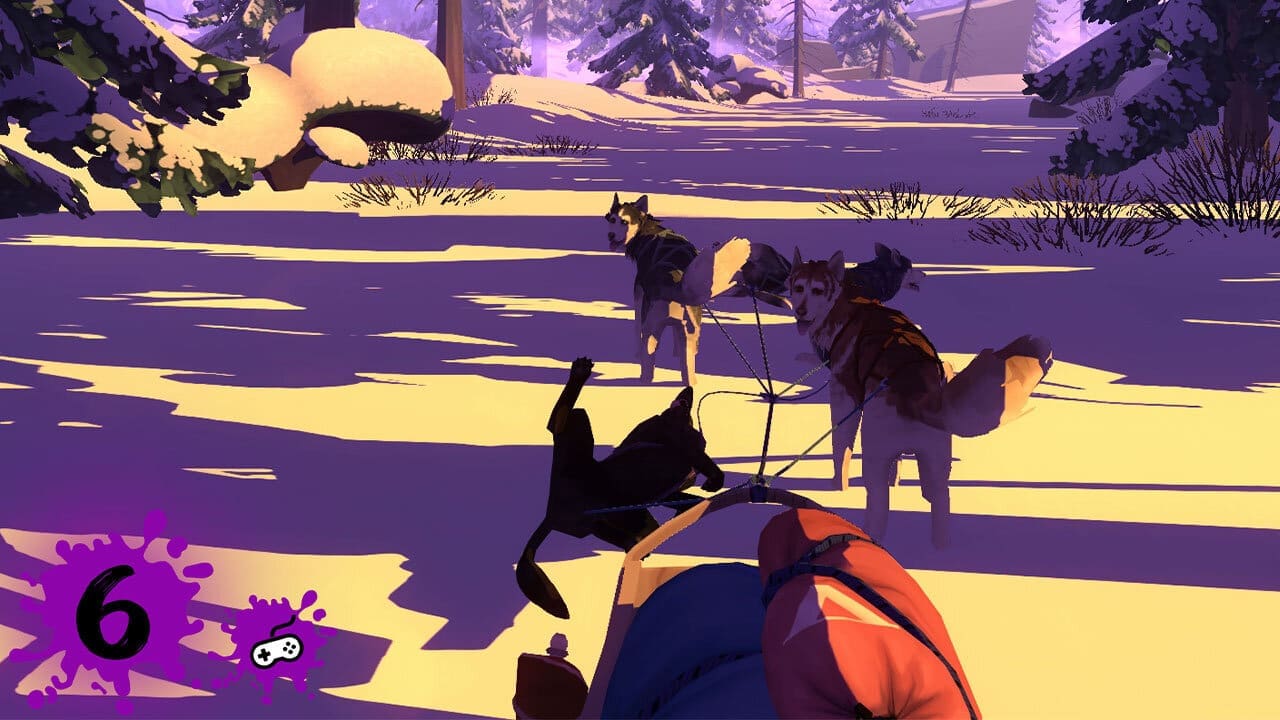
With your five dogs gathered, you set out into the wilderness with little more than what seems like an afternoon of research on YouTube for sled-dog terms. “Haw!” you yell to go left at a fork in the road, and “gee!” to go right at the next. But soon the lack of preparation sets in. You’re out of food and no help is in sight, so you pass out on the ice.
This is where the rogue-like elements come in. Each time you “die” on the ice from starvation or something else, you awaken in your van just before the trip began. What you do bring back from each attempt is knowledge. As you play and interact with more things, you’ll start being more prepared and packing extra meat, birch, or bullets.
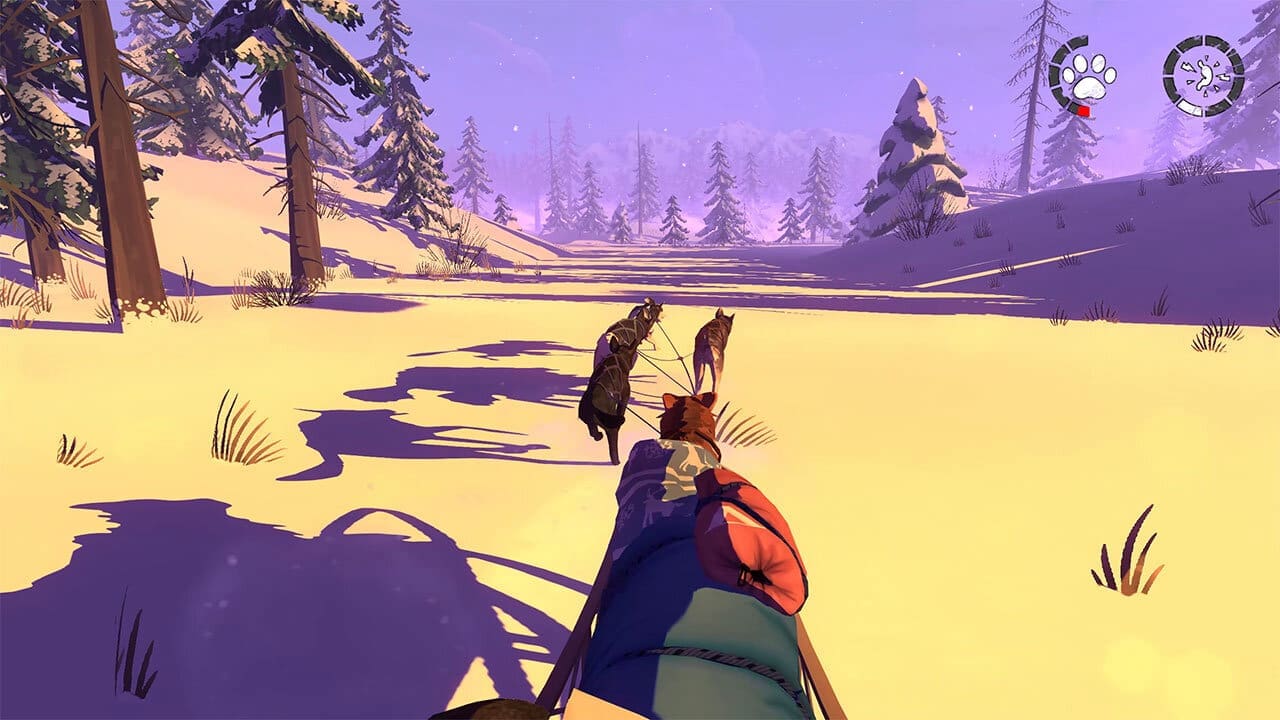
Your journey is kind of on rails and, although I played The Red Lantern on PC, it’s definitely more enjoyable with a controller than leaning over mouse and keyboard. Your sled dogs move you forward and around obstacles automatically; it’s up to you to react to events along the way and, at times, decide which direction to head at a fork. Ultimately, you keep moving toward the goal: the cabin at the end of the map.
As you move forward, you’ll pass trail markers that break the journey into blocks. Between each trail marker, one random event will occur, and the pups will lose one bar of energy. You can also choose to camp at any point just before the next trail marker. This makes the cadence predictable to a degree; you end up relying on RNG events to provide what you need at the time.

When you start the game, you’ll have three bullets for a rifle. If you pass a wild animal — a deer or a flock of birds — you can choose to stop and hunt, providing more meat. Another type of random event will see you spot an abandoned campsite; if you choose to scope it out, you may find a bullet or two. It’ll take a couple of runs to learn what each event does — that’s when the resource-management part becomes important.
Hunting in The Red Lantern is rather confronting at first. Each animal you kill is presented as a majestic beast, and it feels like the game wants you to feel bad about killing them — which I did. It’s odd because there’s no alternative: you need to hunt to progress. There’s no berry-foraging option.
Each action you take removes one bar of energy; when you’re tired, you’ll lose two per action. You need to set up camp periodically to feed yourself and the pups. Birch lets you start a fire and cook meat, although you can eat it cold and risk a cold bite. Sleeping removes the tired status but counts as an action and costs one bar of energy.

Tracking your own hunger, the pups’ energy, trying to hunt animals, scavenging for ammo, and finding time to sleep means your first couple of runs make the journey seem impossible. Even with extra materials packed, you’ll still struggle. It’s not until you come across a couple of key items that you see a major increase in efficiency and progression. The first two are an axe that lets you chop birch with less energy and a fishing rod that lets you gather food when you spot a hole on a frozen lake. There are a few other items as well and, by the time you’re reaching the cabin, you’ll look much more prepared than when you first left.
Unlike most rogue-likes where each run feels fresh, The Red Lantern can quickly become repetitive. There are only so many events, and after you’ve seen them all once, listening to the musher’s reaction becomes an eye-roll. For instance, a wild dog will run alongside you and the musher says “Just stay there,” but it comes in and attacks. You can fight it off in a number of ways — yet every time you hit that event it plays out exactly the same. The same dialogue, the same dog, the same outcome. Adaptive dialogue and even randomizing visual details could have kept the tension alive beyond the first few encounters.
The Red Lantern is all about the journey and, for the first hour or so, it keeps a tone of survival and surprise. But the rogue-lite repetition blunts the impact those moments first had. The regret I felt after my first deer, the fear that wild dog injected — they fell by the wayside, and I became less engaged, skipping dialogue and events I’d already seen.
The Red Lantern is a solid experiment that blends genres. A minimalist art style presents a barren Alaskan wilderness, but you’re never too lonely thanks to a great performance from Ashly Burch as the musher. The game didn’t overstay its welcome at only 3–4 hours, but I can’t help feeling the story and themes Timberline Studio aimed for might have landed harder in a different structure. With all of that said — the game has huskies, they’re cute, and you can pet them!

The Red Lantern code provided for review.