This year’s opening night film for the Melbourne International Film Festival was Memoir of a Snail, the latest from Australia’s Adam Elliot, who previously directed Mary and Max. This latest from Elliot is another claymation feature that has taken him and a team of animators around eight years to finish production in Melbourne. Fittingly, the film is something of a love letter to Melbourne itself, and being able to watch it as part of MIFF and hear from Elliot himself in a Q&A after the film solidified it as an excellent feature for MIFF 2024. But is it a film worth watching with all of that aside when it releases later this year? Indeed it is!
In Memoir of a Snail, Grace Pudel (an excellent Sarah Snook) narrates her own life, telling us how she was born early, just ahead of her twin brother Gilbert (Kodi Smit-McPhee) and we quickly learn she has a love for snails thanks to her mother who died in childbirth. Her father had a passion for street performance before a car accident left him in a wheelchair, and now the family has little money. But they do have each other and a passion for reading. But as we can guess, seeing as how an adult Grace is narrating as if something happens to her brother, the two are separated when their father passes away, and Grace is sent to live with a nudist-loving family in Canberra, while Gilbert is sent to an ultra-orthodox Christian family in Western Australia who run an apple farm.

While parts of the family are filled with many hard-hitting emotional beats, even Adam Elliot himself notes after the film, “Did we put Grace through too much in this film?” It’s not a film without plenty of humour or hope. A big part of that comes in the film’s introduction to Pinky (sensational Jacki Weaver), who arrives shortly after the siblings are separated, and Grace is in great need of a friend. Pinky is an older lady but a loud character who tells wild stories merrily, gives the middle finger to anyone who needs it and provides Grace with a much-needed soul to lean on and trust within. Without her mother, and following her father’s death, Pinky is the closest Grace has had to a proper parental figure in her life; her adoptive parents are too busy trying to push self-help books than attempting to get to know and understand their new child.

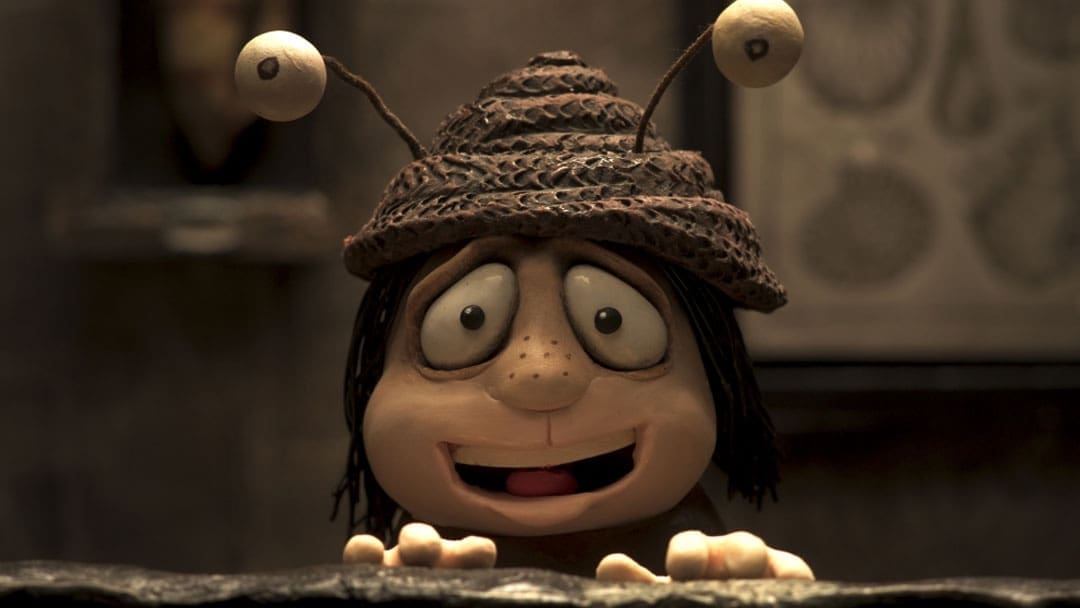
Claymation, while an acquired taste, offers a unique and ‘hands-on’ look. The figures and their surroundings are not perfectly created to hide the human element in their creation. Instead, they are all hand-crafted with zero use of CGI in the film. Fire is cellophane, smoke is cotton wool, and tears are a mixture of things, including lubricant. This unconventional approach results in a visually stunning world and a diverse cast of characters, each painstakingly crafted with a palpable sense of love in every scene and moment.
There’s an inescapable Australian story here, and it’s not just because of the many recognisable Australian locations, in-jokes or slang in use. The love for Melbourne is felt within the film by the characters themselves, seeing that place as their home and separation from it being the central heartbreak point for the film. It’s the Collingwood housing complex, Luna Park visits and the many Chiko Rolls that imbue the film with an Australian culture I haven’t seen on film before. It feels more like a film set in Melbourne than most live-action films in the city I’ve seen.