
Every year, PAX Australia features a selection of games under the ‘Aus Indie Showcase’ label. These games have been selected from across Australia, either recently released or upcoming, as deserving of a spotlight.
For the 2025 selection, there are six video games and six board games. You can view the complete list here, along with additional details for each game.
We’ve had the opportunity to chat with some of the team behind the games that will be featured during PAX AUS 2025 and have been able to get some questions answered about the games, as well as the teams themselves. In the lead-up to PAX AUS 2025, please enjoy this series of articles offering insight into some of the featured games.
| GAME NAME: | MEMORY’S REACH |
| DEVELOPER: | 100 STONES INTERACTIVE |
| INTERVIEW WITH: | BEN DROSTE |
What does it mean to you to be included in the PAX Rising
It’s an honour to have been selected for the showcase. Every year, I try to check out the showcase games as there are always really fun and interesting games on display, so I’m excited to be a part of it this year.
What’s the best pitch to get people to play and check out your game at PAX AUS this year?
Memory’s Reach is a first-person puzzle-based metroidvania. If you like getting lost in a complex interconnected map, solving tricky environmental puzzles, and searching every room for sneakily hidden secrets, this is the game for you! And the demo at PAX this year includes a brand new area – featuring a fun new player ability and some particularly challenging puzzles. So if you’ve played the game at previous shows, come give the new demo a go and see how far you can get!
Can you tell us about your team: size, roles, and how you collaborate
It’s a very small team. 100 Stones Interactive is a one-person studio, so generally, I take a Creative Director role when working with contractors to fill gaps where I lack the skills myself. So in general, I’m responsible for the art, design, programming, as well as various other tasks. Meanwhile, I work with other talented artists who are handling the sound, music, narrative, and marketing. I’d say around 8 or so people have contributed to Memory’s Reach in a substantial way during its development, and the game wouldn’t be where it is without their contributions.
Can you discuss the story hidden in the discovery of the doomed civilisation? Will players be able to piece together something fluently, or will it be left more mysterious?
How much of the story is revealed is very much up to the player piecing it together. By scanning objects throughout the world, you can gain some lore and backstory to help understand the situation, and the main plotline is delivered via writings left behind by the civilisation. A lot of the most pertinent information is pretty easy to come by, as I want players to have a pretty good understanding of the story by the time they reach the end of the game – even if there are a lot of lingering questions. But to fully understand what happened and really complete the game, you’ll need to hunt down all of the log entries and piece it all together more fully. So the game will reward players who take the time to really delve in and hunt down all of its secrets.
What are the different sorts of puzzles players will be solving in the game?
Broadly speaking, puzzles come in three categories:
-
Holographic logic puzzles. These are UI style puzzles of varying complexity accessed from terminals throughout the game. These puzzles are generally used to do things like unlock a door, turn on a device, or otherwise unlock the way forward.
-
Room-based environmental puzzles. These puzzles involve manipulating the environment in some way (raising platforms, rotating bridges, triggering devices, etc) to “solve” the room. Think games like The Talos Principle and Portal. These “puzzle rooms” are the most common type of puzzle in the game and make a lot of use of the various player abilities and upgrades you collect throughout the adventure.
-
Zone-wide meta-puzzles. These puzzles involve navigating multiple rooms or making big changes to the layout of the current zone. Think something like a Legend of Zelda-style puzzle dungeon, where you might need to backtrack or alter things in multiple rooms to proceed to the end. Generally, these will reveal themselves after you’ve had a chance to explore the area a bit and learn the layout, and now you need to look at the zone in a more holistic way in order to figure out how to navigate it or manipulate it in such a way as to proceed forward.
Which puzzle or exploration mechanic in Memory’s Reach are you most excited about?
It’s actually a bit of a blend of both exploration and puzzle solving, and I’m most excited about it. The interconnected nature of the metroidvania-style map – which twists and turns and reconnects with itself in unexpected ways – means there are a lot of sneaky shortcuts and skips built into the game, and lots of opportunity for hiding secrets. Some of these require really good knowledge of the world layout, while others require solving puzzles in creative ways or creative use of the player’s abilities. Once you have a good understanding of how the different abilities work and start noticing patterns in the world, you’ll find there’s a deep layer of secrets to the game that isn’t immediately obvious on the surface, so I’m really eager for players to jump in and start exploring.
How do you balance the puzzle and exploration mechanics to work for different types of players who may only be used to one genre over the other?
Memory’s Reach has a heavy focus on both exploration and puzzles, and I hope that things like the environmental and meta-puzzles blend into the exploration in such a way that one naturally feeds into the other. So I think there’s room there for people to enter the game focusing on the aspect they’re most familiar with, and hopefully the game will naturally encourage them to delve more into the other aspect as they become familiar with the game. That being said, if you follow the main path through the game, you’ll get a good sense of the story, and it will involve comparatively easier puzzles and won’t require venturing off the path too much (I’m also planning an optional waypoint system to help point the way forward for players that need it). But to complete the game 100%, find all the hidden areas, fully reveal the story, and discover all of its secrets will involve tackling the most difficult puzzles and require some really thorough exploration of the world.
What did you learn most from your previous game, The Eyes of Ara, and have implemented into Memory’s Reach?
While I had a lot of experience in game dev before creating The Eyes of Ara, it was still the first game from my fledgling studio and was also a mostly solo project – so I learned a LOT. But I think the biggest takeaway that players will appreciate is this: I was unsatisfied with many of the puzzles. I felt like many of them were not as complex and interesting as they should have been, and in many cases, the most obvious solution was the correct one. So for Memory’s Reach, I knew I wanted to do a lot better in this regard, focusing on fewer puzzles but spending a lot more time making each of them much more fun and interesting to solve. I also wanted to make the game a lot more open to exploration and experimentation, which works well with the environmental puzzle design focus of this game and allows me to build in lots of interesting secrets that weren’t possible in Eyes of Ara.
How have you attended PAX before, and what’s your favourite Aussie game you remember checking out?
I’ve attended PAX many times, and even when I’m not exhibiting, you’ll often find me hanging out almost exclusively in the indie section (that’s where all the most interesting games are, in my opinion 😉 ). One game that stood out to me in recent years was The Dungeon Experience – it had a very fun and absolutely hilarious demo. I’m really looking forward to getting my hands on it when it releases.
What’s the most recently played/watched/listened to Aussie thing that you loved?
I’m going to cheat with this question because I haven’t actually seen this yet, but I’m really keen to check out the new Game Worlds exhibit at ACMI here in Melbourne. While there are games in the exhibit that aren’t Australian, there are a few in there that are, such as Silksong, as well as all the great stuff in the permanent Games Lab exhibit. I love revisiting this exhibit every few years and seeing all the new content, things like behind-the-scenes development sketches, design notes, etc. It’s really inspiring to see this legacy of Australian film, television, and games all on display and know that in some small way I’m contributing to that history too.
Thank you to Ben for taking the time to answer the questions and help us learn more about the game! You can now add the game to your wishlist on Steam.
You’ll be able to find Memory’s Reach at the Indie Showcase Area, which is not far from entering the PAX Hall via the Que Hall, as circled on the map below. 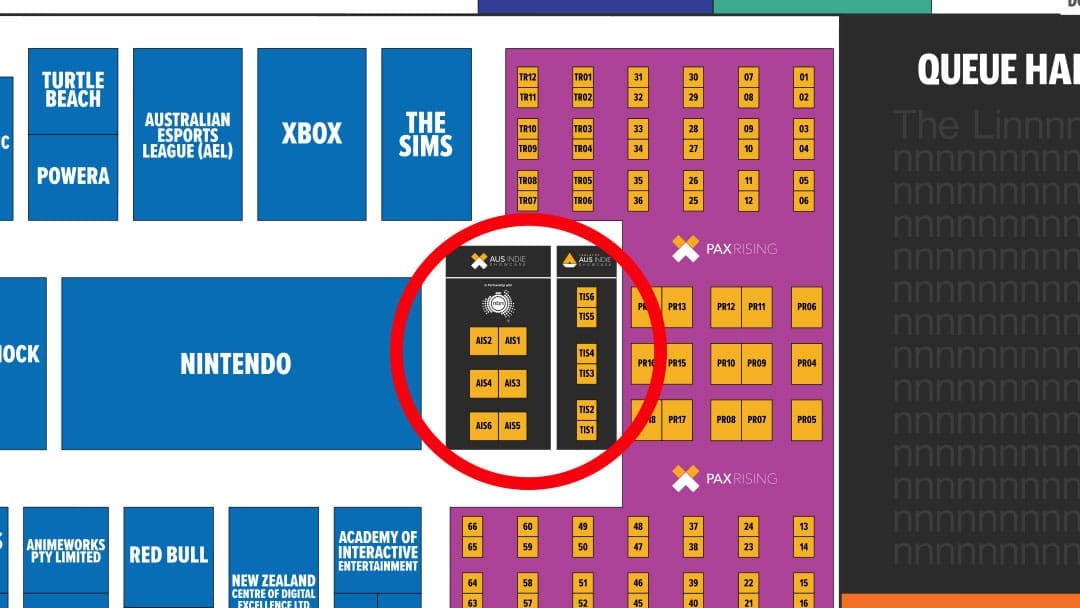 For more on PAX AUS 2025 from Explosion Network — click here!