
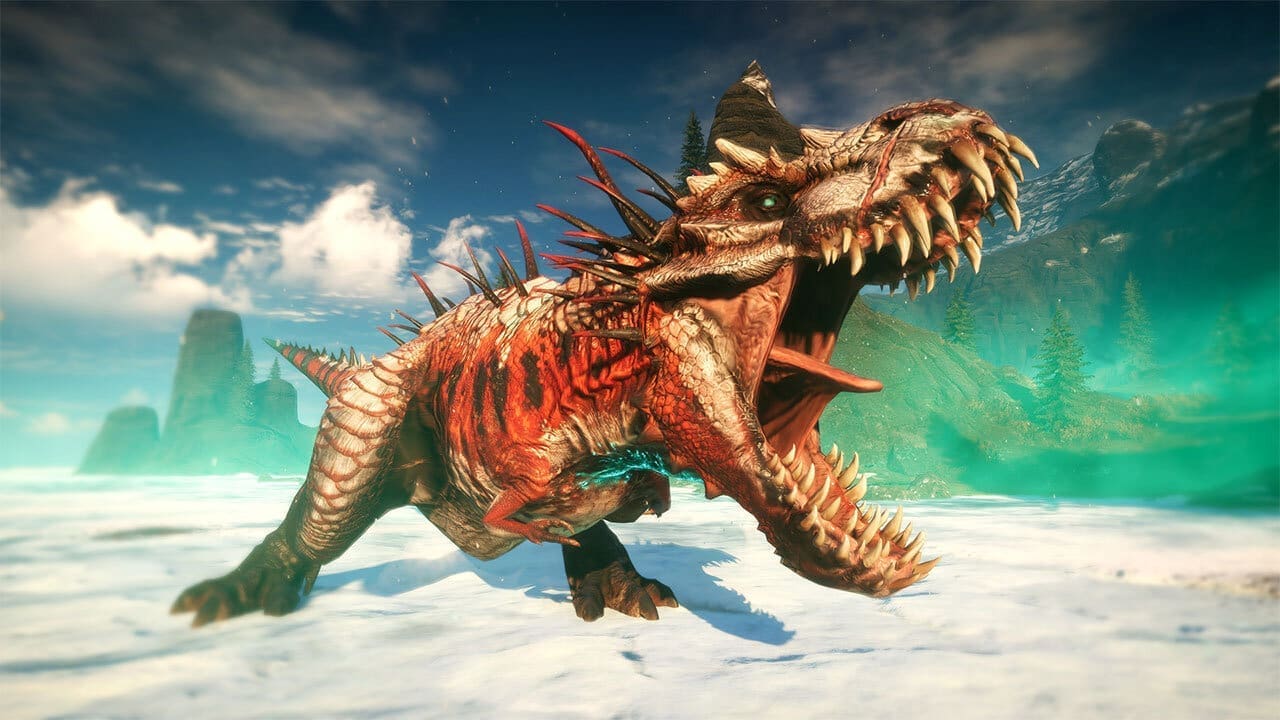

As you roam the dinosaur-infested Earth while playing Second Extinction you’ll realise one key thing pretty quickly: these are not the dinosaurs from Jurassic Park. You’ll see some familiar types—including the frilled-neck spitter that killed Wayne Knight in the first film—but otherwise these dinos are a different breed. One species wears armoured plates like boxing gloves, another burrows underground, and there’s even one that rockets through the air as a bolt of electricity. The T-Rex is as daunting as you’d expect, but it also glows red in a rage of bio-mutated power and can kill you in an instant.
Second Extinction takes place on one large map broken into several zones, each with its own points of interest and mission objectives. You can drop into a mission (literally drop to Earth in a pod), complete the core objective, and call in a ship for extraction. Or you can explore and tackle secondary objectives to gather materials for weapon upgrades and earn XP for levelling your character.
Sub-objectives range from clearing dino-goo off a satellite to protecting a downed ship while it repairs. Core objectives aren’t much more expansive either—usually you hold a button to activate something and then fight waves of dinos before moving on.

As a package, it’s easy to describe Second Extinction as Left 4 Dead meets Deep Rock Galactic: there’s a lot to kill, but the open-world map leaves room for you and your squad to explore.
Although you can play solo if you’re a masochist, Second Extinction is built for teams of three. I’ve played with both matchmaking randos and a pre-made with Ciaran and Ashley from Explosion Network. The latter is preferred—Discord call, coordinated objectives, and the necessary shit-talk always make these games more fun.
After picking one of four classes you can jump straight in. My preferred was Rosy, a tank with a minigun and placeable electric fences. The other three include a support specialist who can highlight enemies, a sniper who hits weak points for big crits, and an evasive assault who can dash out of danger.
My allegiance to the tank class was less about abilities and more about the arsenal. As fun as it is to pop dino heads with the grenade launcher available to Amir (support), the minigun seemed like the best bang-for-buck weapon in the game. Weapons need a lot of fine-tuning: the assault rifle feels underpowered and the shotgun—which deserves to feel badass in this of all games—fires like two underpowered gender-reveal pellets of smoke. And the grenade launcher, surprising as a primary, doesn’t feel strong enough. I want dino-guts to fly and to feel like it’s a tool I should save for key moments.
When explosions are going off all around you, there’s an appreciation for the Apex Engine. Second Extinction isn’t stunning, but it has moments of beauty, and the blasts from ominously placed barrels are a thrill.
A great dodge saves my ass, but the artillery support from a friend was needed to finish the job.
Fortunately, the lack of explosiveness in some weapons is often at the back of your mind as you work not to be overrun. The smaller dinos feel like pests, but they’re doing their job—distracting you from bigger threats. A giant turtle-like dino has a tough outer shell and needs to be flipped before you can deal real damage. A fast rhino-like dino inflicts high levels of damage, but you can chip away at its armour to reveal weak flesh. These “puzzle” elements are among the game’s strongest points, and I hope future dinos demand new tactics.
As you tear through enemies you’ll pick up parts to upgrade guns between missions. Why you need dino bits to upgrade firearms, I’m not sure, but it’s a satisfying path nonetheless. Each weapon has its own tree, and with each class having unique loadouts there are plenty of upgrades to chase.
At rank 5 you can pick up to three active contracts at a time for bonus materials or skins. Choosing from a list—rather than being stuck with three random dailies—is nice.
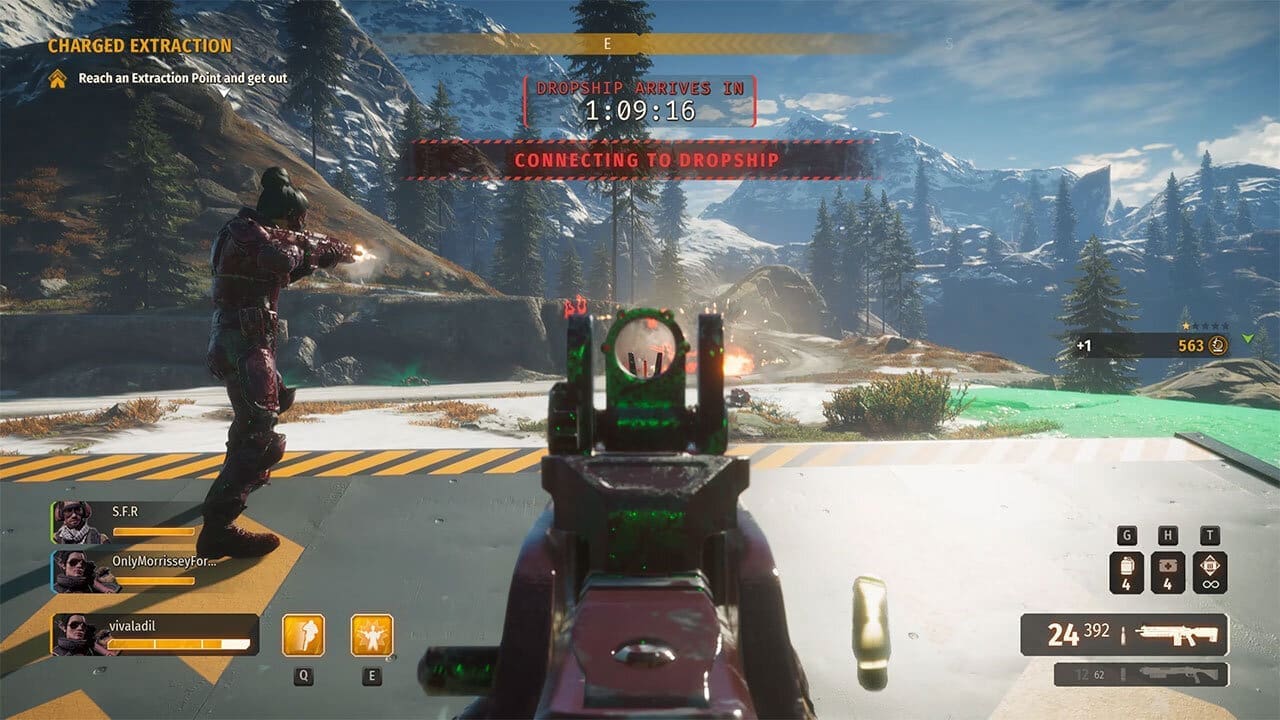
Looking at the map—either before choosing a drop zone for one of the nine missions or after landing—you’ll see each section has its own rank. High-tier areas feature stronger dinosaur activity but also better chances at rare drops needed for upgrades. A server-wide “war effort” sees areas rise or fall in activity depending on how often players clear them. Apparently, if a zone hits a critical unattended point a special event triggers, though I haven’t seen that yet.
Early Access bugs popped up: a few looping VO lines, dinos literally flying into the air, and a menu bug that blocked weapon upgrades until a restart. Nothing wild, but worth noting nonetheless.
As it stands, Second Extinction needs some major tweaking—especially the guns—but there’s a solid core here, and when it fully launches on PC and the Xbox family of consoles it could be one of 2021’s best co-op experiences.
Trying to dodge several of these fast-moving beasts at once is a struggle.
Buy Now or Wait?
If you’ve got a group of friends you’ll play Second Extinction with, it’s moderately priced at $35.95 AUD and can be a lot of fun. If you’ll be matchmaking most of the time, I’d wait until full release—or a substantial Early Access update.


![Blacktail Preview [Steam Next Fest, February 2022]](https://b3313143.smushcdn.com/3313143/wp-content/uploads/2022/02/Blacklight-Preview-Thumbnail.jpg?lossy=2&strip=1&webp=1)