
Knife: The Attempted Murder of Salman Rushdie Review [MIFF 2026]
This film is a mixture of watching Salman recover and reconcile with his attacker, as well as a deeper dive into his earlier life and the events that led to this moment.

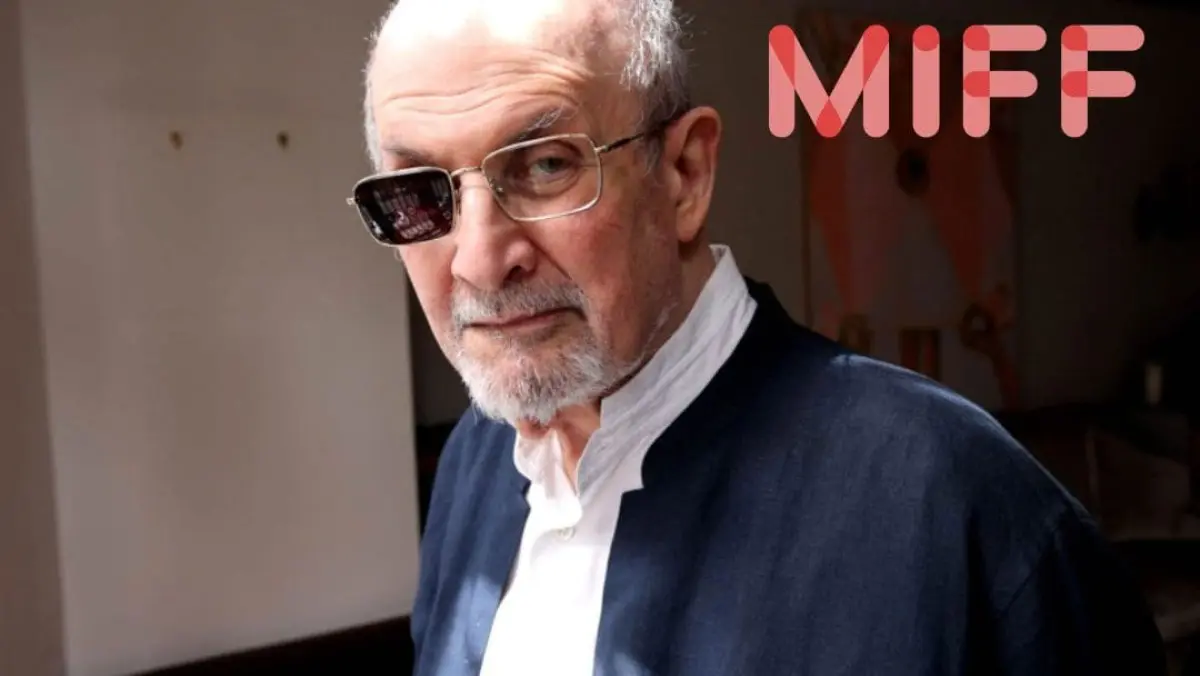
Alex Gibney makes the smart choice to save the intense, visceral and hard-to-watch footage of the attack on Salman until the end of the film
 Salman Rushdie had an assailant attempt to murder him in 2022 right as he entered a stage for a talk. The visceral, hard-to-watch footage in this documentary by Alex Gibney is paired with personal, intimate hospital footage of his recovery. The film is centred around Rushdie’s recovery as well as the reasons that led to someone wanting to take his life in a public space in such a violent way.
In 1988, Rushdie published ‘The Satanic Verses,’ a fictional book that caused him to receive numerous death threats from Islamic fundamentalists and for years following, he was basically in hiding. He’d have several near-death moments, with these being foiled and diverted before they could happen. Still, others involved in publishing his novel, translators and publishers, have not been as lucky, with several being murdered.
This film is a mix of watching Salman recover and reconcile with his attacker, and a deeper dive into his earlier life and the events that led to this moment.
The film combines words from his book Knife: Meditations After an Attempted Murder with footage shot by his wife Rachel Eliza Griffiths while Salman recovers. Moments from his book, like when he talks to his attacker, whom he refers to as “The A,” are recreated here with Salman facing him in a fictional scenario where he asks him questions through a jail cell. The majority of it is based around “why?” His attacker, at 24 years old, wasn’t even born when he published The Satanic Verses. This shows just how far violent rhetoric with a religious aspect and a call from a higher figure of power can make people do violent acts, all without question.
In the years since his fatwa was issued on his life, Salman has spent a lot of time talking about the freedom of expression and the ability for anyone to write and express themselves, especially when it comes to questioning religion, which although some may beleive is off the table, he believes should be questioned more—especially if it’s going to cause people to turn into violent assassins.
The footage of Salman in hospital can be horrific. He’s bruised, has massive cuts up his body, his neck is sliced and stitched up, and, the big one, he’s lost his right eye, which, seeing the effects of a knife to an eyeball, is… well, it’s haunting. Salman was stabbed fourteen times, and his wounds show the horrific nature of his attack. And as the film points out. The choice to use a knife. To get up close and personal. is so much more violent and personal in nature than that of a gun.
Alex Gibney makes the smart choice to save the intense, visceral and hard-to-watch footage of the attack on Salman until the end of the film. By this point, you’ve seen it discussed from multiple angles, and Salman is now back in the place where the attack happened, allowing it to be viewed both as the grotesque act it is and as a testament to the preservation of the human spirit and body.
[Dylan attended a screening thanks to the Melbourne International Film Festival]
Knife: The Attemped Murder of Salaman Rushdie Review
Freedom of discussion, and especially that around religion, is the basis for what starts the violence behind the attack on Salman, but as this documentary shows, there's a continued bravery in the choice to keep that discussion alive amidst such terrible and violent threats and attacks.

Dylan Blight
[He/Him] Dylan Blight is the Founder and Editor-in-Chief of Explosion Network, an independent Australian publication covering video games, film, television and pop culture. Since founding Explosion Network in 2017, Dylan has written and produced reviews, news, interviews, features and podcasts across the entertainment industry, while overseeing the publication's editorial direction and content.
MORE FROM DYLAN BLIGHT →

Comments