AEW: Fight Forever Review

Synopsis: Developed by YUKE’s, AEW: Fight Forever combines nostalgic arcade-wrestling with All Elite Wrestling finishers and moves. Featuring a big roster of AEW talent, multiple match types, a career mode, customization options, more than 40 weapons, and more.
Reviewed on: PlayStation 5
Also available for: PlayStation 4, Xbox Series X|S, Xbox One, Nintendo Switch, PC
Cast: AEW Roster & Production Crew
Developer: Yuke’s
Publisher: THQ Nordic
In 2019 Tony Khan, co-owner of the NFL’s Jacksonville Jaguars and the EPL’s Fulham FC, formed All Elite Wrestling. Tony was not just a billionaire businessman with cash to splash. He was a lifelong passionate wrestling fan. Like many lifelong fans, he had become disillusioned with the mainstream wrestling landscape in North America. Many felt that the WWE, formerly known as the WWF for lapsed Attitude Era fans, had rested on its laurels. Despite huge financial growth and success, the on-screen “product” had become stale due to a lack of any real competition since they purchased their main rival and competitor, WCW, in 2001. The move to PG programming and focus on sports entertainment over wrestling alienated a segment of the fanbase that craved a genuine mainstream alternative. With the help of four of the most popular independent wrestlers in the world (Kenny Omega, Cody Rhodes, Matt and Nick Jackson), Tony Khan formed AEW as that alternative. AEW’s focus on in-ring wrestling, long-term storylines, diverse characters and a more mature, adult-skewed product for hardcore fans set its mission: change the world and start a new revolution for professional wrestling.

Why is this company and industry context and backstory important, you ask? Because much like the on-screen product, wrestling fans have been craving a video game to return to the glory days of the much-beloved wrestling games of the late 90s and early 2000s. One of those games, WWF No Mercy for the Nintendo 64, is considered by many to be the greatest wrestling game ever made. Several AEW wrestlers are massive gamers, and based on the gameplay and art style, it’s clear that the inspiration for Fight Forever is WWF No Mercy. WWF No Mercy director Hideyuki Iwashita was even brought in to assist with development. AEW delivered in becoming a successful mainstream alternative to WWE, as they promised. So, does Fight Forever deliver on its promise of being a modern-day successor to No Mercy and a return to form for arcade wrestling greatness? Almost.
The one aspect that Fight Forever undoubtedly excels at is the gameplay. It nails the easy-to-pick-up-and-play, hard-to-master arcade experience promised. Basic controls are simple, with the face buttons being strike, kick, run and grapple and L1 and R1 acting as grapple and strike reversals. There are more complex actions like springboard dive moves, picking up prone opponents, and repositioning your wrestler to hit them with a move from behind, but the basics are enough for any beginner or first-time wrestling fan. I had four friends over that had various degrees of wrestling game experience that ranged from playing every WWE 2K title to not having played any for a few years and another who hadn’t played at all. Everyone had the hang of it within 1–2 matches, and the laughs and excitement of the back-and-forth action made for an awesome, fair and balanced multiplayer experience.
Much like No Mercy, the key to winning is filling your momentum meter. Each time you land a strike, grapple or counter, your meter fills. If you fill it enough, it will put you in a signature state where you can hit harder-hitting and iconic moves. Performing a taunt in this state will put you in the special state to hit your finishing move. Just like No Mercy, hitting signature and special moves are accompanied by multi-shown replays that add that nice little touch and highlight the significance of hitting those moves as they, more often than not, usually finish the match. The back-and-forth cat and mouse of opposing momentum bar states makes for exhilarating strategic decisions on when to strike, grapple or counter. The only slight annoyance with the gameplay is having to mash buttons to escape pinfalls or submissions, not knowing how close or effective you are to escaping at the possible expense of destroying a controller. Although frustrating, I like its simplicity and prefer it over a collection of weird quick-time mini-games in more contemporary titles.

Overall, the execution of the moves and the arcade feel of the gameplay is impressive. A training mode helps hone your craft, and in-game tutorials from William Regal explain gameplay nuances on the more challenging or complex moves that hardcore wrestling fans will want to exploit to recreate exciting sequences. Whilst helpful, I had to figure out some advanced moves, like throwing someone in and out of the ring in specific states, standing or grounded, to hit or recreate diving moves such as a tope suicida. Not essential to core gameplay, but the tutorials or controller scheme could have explained some of the advanced setups and placements better.
The other area Fight Forever excels is its sound design. The crowd chants, including chanting each wrestler’s name; wrestlers say little quips during matches, and when you hit an opponent with a move and they hit the mat, you can hear the thud of the impact. It all adds to that authentic experience and AEW’s focus on wrestling and returning to basics. Some fans from more contemporary games may be surprised or disappointed that there is no commentary, but I didn’t notice the absence of commentary until 1–2 hours into the game. Commentary in wrestling and sports games can be hit or miss with execution and repetition. Maybe I have been conditioned by older wrestling games or the more recent and excellent Fire Pro Wrestling, but I think no commentary not only works here, but it elevates the gameplay, immersion and experience.
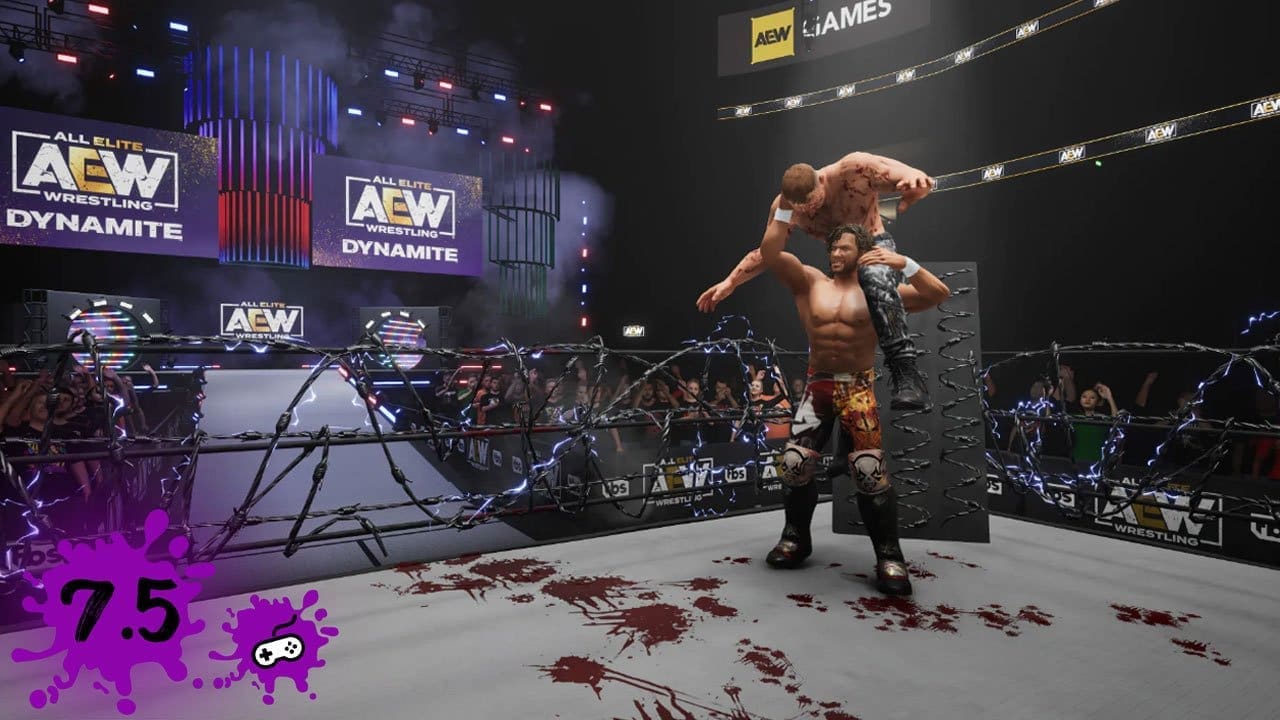
On launch, the base roster contains 52 wrestlers with two versions of Matt Hardy available as preorder bonuses and the Elite Edition or Season One Pass allowing you to download Cash Wheeler, Dax Harwood, Keith Lee, The Bunny, HOOK and Danhausen at some point after release. The roster is definitely a bit thin, especially in the women’s division, with only 12 wrestlers. Some of the omissions are bizarre. Some wrestlers included debuted after others that don’t feature. The season pass with six wrestlers is a great idea, and their roster shouldn’t be a massive problem if Fight Forever‘s ongoing support is strong, but the pricing of the passes hasn’t been outlined yet. Even more so, it hasn’t been detailed if wrestlers from that can be purchased with in-game currency. The other frustration is the lack of match types. There are 10 match types, with 4 of them being 1v1. No Trios is understandable if six on-screen was a limitation, but no tag team ladder match, cage match or Blood & Guts match is bizarre since they have featured so prominently in AEW’s history. I will give credit to the exploding barbed wire death match and the lights-out match. The use of weapons is hit-and-miss, but the blood effects in these matches are like a car crash — blood on the front and back of the body, the face, staining the mat. Impressive for those wanting to recreate AEW’s more extreme side. Thankfully blood can be turned off in the settings for those inclined.

The other two prominent modes of wrestling games that fans adore are the Create a Wrestler (CAW) and Career modes. Sadly, the CAW mode feels extremely bare and basic in Fight Forever. Those wanting to recreate rosters from rival promotions, favourites that need to be added or create originals to simulate or book their own fantasy CAW federations will be sorely disappointed. No community creations can be shared, so it’s back to scouring forums and dedicated CAW sites for formulas and templates. I don’t see that as too much of a problem, but the lack of options can’t be ignored. Even if they add more cosmetic options, I feel this is one side of the No Mercy-ification of Fight Forever that is stuck in the past for the wrong reasons. I was sorely disappointed to see a lack of basic shapes, numbers and letters and no free-layer option to put onto my character to recreate website or podcast logos or tattoos I have.
I look forward to what the creative and talented CAW gods can produce post-launch but temper your expectations.

The other big mode Fight Forever offers is Road to Elite. It acts as a single-player career mode in which you can choose an existing or created wrestler. It consists of four blocks, each corresponding with the four big PPVs of AEW: All Out, Full Gear, Revolution and Double or Nothing. Each block contains 3 of Dynamite’s weekly shows, with the 4th week being the PPV. You can complete four turns before competing in each week’s Dynamite. The options for a turn consist of working out, dining or going out. These actions will either earn you skill points, cash or both. Some may make or deplete energy or mood, affecting your likelihood of getting injured in matches or workouts.
If you’re using an existing AEW wrestler in the game, you can’t use the skill points to upgrade your wrestler’s stat, actions, or passive skills. So, the incentive is really to experience the different branching storyline options. This isn’t a problem for mainline characters, as their unique skills give them personality and differentiate them from each other and is one of Fight Forever‘s major strengths. With a CAW, the cash and skill points you earn can be spent on those three types of skills. No wrestler has maximum skills in the game, so allocating your points to the right skills is important to form your wrestler’s style and in-ring options. The problem is that you can’t assign a set of points to created wrestlers, so each CAW must be taken through Road to Elite to upgrade their abilities: just another limitation, restriction and lack of incentive or freedom in making CAWS.
There are three different storyline branches in each of the four blocks for some replay value, but it’s difficult to know what triggers each path, and I found myself repeating various ones despite choosing different dialogue or having different results. I did love the real cutscenes they showed after completing certain story blocks or running into specific characters. Some included CM Punk’s return or the formation of Death Triangle as a stable. It’s an excellent informative nod to their history. Unfortunately, the in-game cut scenes and dialogue in Road to the Elite aren’t the greatest and, once again, may be a letdown for people wanting a more in-depth and longer experience. It took me maybe 1–2 hours to complete, and it feels like it’s designed to repeat with new CAWS or to choose different AEW characters, but even after 2–3 runs through, it may get repetitive, and you find yourself skipping straight to the matches or worse yet just playing exhibition modes.
As a lapsed wrestling fan, AEW reinvigorated my love and passion for wrestling. If you are an AEW fan and/or prefer the old-school easy to pick up and play, hard-to-master arcade style of wrestling and gameplay is a priority, then you will have a blast. From a pure gameplay perspective, AEW: Fight Forever nails it. From a creation and career mode perspective, not so much. In these modes, they took the “make No Mercy but for current consoles” too literally. I’m just thankful we have an alternative that exists that is fun and feels fresh but familiar.

(All Elite Wrestling: Fight Forever code provided for review)