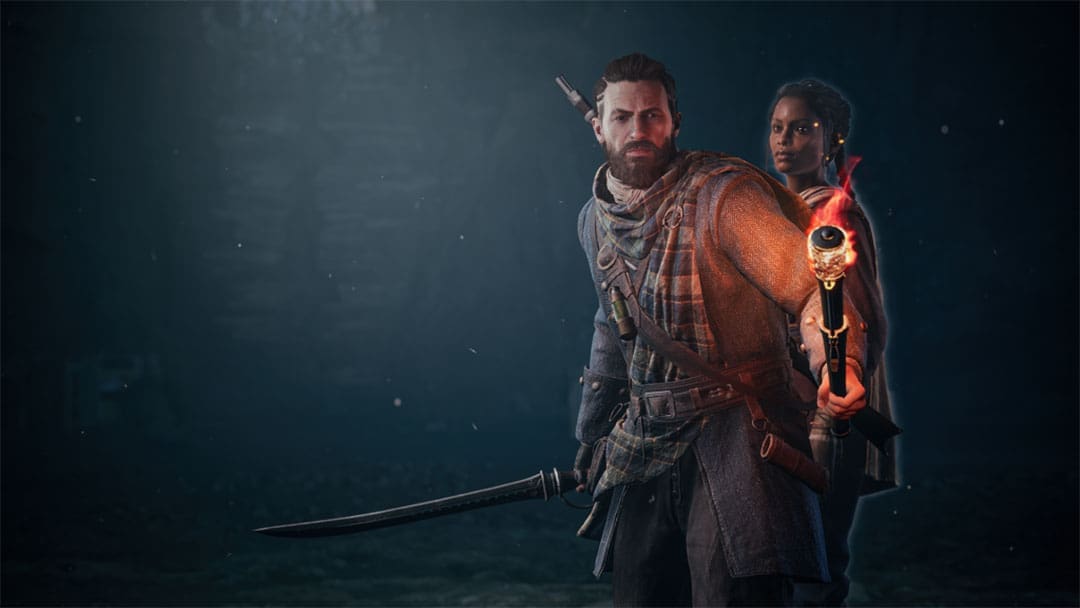
Don’t Nod has released 2024’s first truly surprising video game release with Banishers: Ghosts of New Eden. The 17th-century setting, ghost hunting and ethereal switching combat are all highlights, but building off what they do best, the characters, their relationships, and their story make this game unique.
Antea Duarte and Red mac Raith are Banishers. Aka ghost hunters and they’ve been called to America and the recently colonised New Eden Town to help see to the end of a ghost haunting everyone there. However, not seeing the threat beyond a mild one, their first encounter with the spirit ends with Red Mac Raith barely alive and washing up on a beach some distance from New Eden Town, and Antea Duarte, now a ghost, having lost her life in the fight.

Your first of many choices in Banishers is to either attempt to bring Antea back to life when you get her body back, or to give her her ascent to the afterlife. The former could be considered the light path, and the resurrection is the dark path as it goes against everything they would have stood for in the past as Banishers. Their relationship is more than just that of Antea as the master and Red a padawan learning how to be a better Banisher; they are also lovers, and it’s this connection that drives them and challenges them on their trip back to New Eden Town, and through the many smaller communities they meet along the way.
To resurrect Antea, the two must kill as many lively humans as possible throughout the game. These choices come at the end of a case, where you can choose to Banish the ghost, give it its ascent, or blame the person who is alive, which will kill them. Most of the time, I’d lean towards a Banish or Ascent option. The ghost was evil bad and deserved to be pushed out of this world, or was good and needed help moving on. A few times, the Blame option felt necessary, with the person being alive at fault for the death of the ghostly person or something along those lines. But to resurrect Antea, I would have needed to ignore all sense of right or wrong and kill to bring Antea back to life. It seems pointless as you’d have to go against your gut. But that’s the point and the pull of emotions that Don’t Nod want the player to go through. You know it’s not right, the characters know it’s not right – but will you do it because you want to see Antea back alive in her own body?

It’s nearly impossible not to wish there wasn’t another way, as Antea and Red Mac Raith are two of the most genuine and well-written characters I’ve seen in an AA or AAA game in some time. Their romance is one of the best and most mature I’ve played in a video game. It feels natural and not built upon the backings of some fairy tale setting, and their love isn’t felt in intimate scenes or big and loud scenes of shouting or professing one’s feelings. Antea and Red are, for the most part, very open with one another, and it’s the conversations they have and how they talk to each other that enable you to understand their history without having it spelt out for you and feel the inner turmoil each is facing without being able to hear it.
Following the eventful prologue, you’ll work slowly back towards New Eden Town but bump into remnants of the townspeople, now setting up smaller settlements, having given up on saving their town and instead attempting to find a new home. The secrets of New Eden Town follow them, with many characters, either in primary or optional haunting quests, having a secret to hide, which will begin to peel back layers of what has been happening in New Eden Town. Some of these are long quests that’ll send you into the dark and mysterious woods in search of clues, missing people, long-lost relatives and more.

Every one of the haunting cases in Banishers: Ghosts of New Eden is worth playing, with the optional ones feeling just as important as the main quests. In one of my favourites, Antea and Red come accross a couple who are not too similar to them. One is a ghost, another alive, yet the spirit lingers to be with the one they love. And it’s in this moment that the two, all too knowing how it may sound, attempt to persuade the others that the spirit should move on. Two optional hauntings allow the game to explore two characters squarely outside the white colonisers, who have been in New Eden Town for some time and freshly moved to the Americas, thinking it would fetch them riches and success that couldn’t be found in Europe. Two women seek revenge against men who have wronged them. A Native American woman will seek it on a man who has undoubtedly wronged her and a Black soldier against another under the brutish implied racism and sexism. These two stories offer insight into not only the time period but also Antea’s strong and willful defiance in a time of ignorance and hate. Something you only briefly get to see during the prologue chapter when it’s assumed that Red is the lead Banisher.
On the journey back to New Eden Town, both Red and Antea must fight ghosts, ghouling creatures, and a couple of boss encounters. Combat is simple but fast-paced and built off a great system in which you can press a button to swap between the two characters. Antea is best at taking down spirits who have taken up a physical form and has access to ghostly AOE and other abilities. Red does more damage to ghosts themselves with his swords and will get access to a rifle, which can deal plenty of damage to enemies’ weak spots and take down spectres camping on a ledge. I enjoyed the combat in the game but did find it got tiresome in the later third of the campaign, especially as Antea got access to more abilities, but the enemy types didn’t grow. Once you’ve reached the halfway point of the game, you’ve probably seen every kind of enemy in the game outside of the unique boss fights. And although these are well-designed and feel different enough, it didn’t alleviate the problem with the rest of the game’s combat.
I played Banishers: Ghosts of New Eden in resolution mode, opting for the cinematic 30fps over the 60fps option that is available. I had nearly no problems with this option, but it would encounter the odd slow-down every few hours of play that would often happen during busier scenes or when I was taking on a lot of enemies. Most impressive is just how good the game looks. I know that Don’t Nod falls nicely into the ‘AA’ spectrum, yet this is easily their best work. If I wasn’t fighting ghosts or looking for clues, I was happy to jump into the game’s photo mode and snap away.
Outside of the lack of enemy variety in the game’s back half, the most lacklustre feature was adding a gear system. Although you get skill points as you level up and use these to give Antea’s abilities more power or Red more health, the gear options felt flat and like a checkbox addition following similar third-person action games. I would upgrade things, not caring or feeling like it made any difference, and the money you earned throughout the game, which allowed you to buy other gear from merchants, felt just as useless.
(Review code provided to Explosion Network.
Read about our review and ethics policy here.)