
Synopsis: Inkulinati is an ink-based strategy straight from medieval manuscripts, where a rabbit’s bum can be deadlier than a dog’s sword. Become a master of the Living Ink, build your own bestiary, defeat medieval superstars and collect perks to unleash hidden powers.
Reviewed on: PC
Also available for: Xbox Series X|S, Xbox One
Developer: Yaza Games
Publisher: Daedalic Entertainment
At its launch into early access, Inkulinati already feels like a game that can stand on its own two feet, proving a positively eccentric experience in its current state. It stands tall because its identity is clear and realised for a title still in development. Inkulinati‘s tactics are engaging, challenging and already with a great amount of variety while also exuding a boyish charm in the little details that further the engagement with the title.
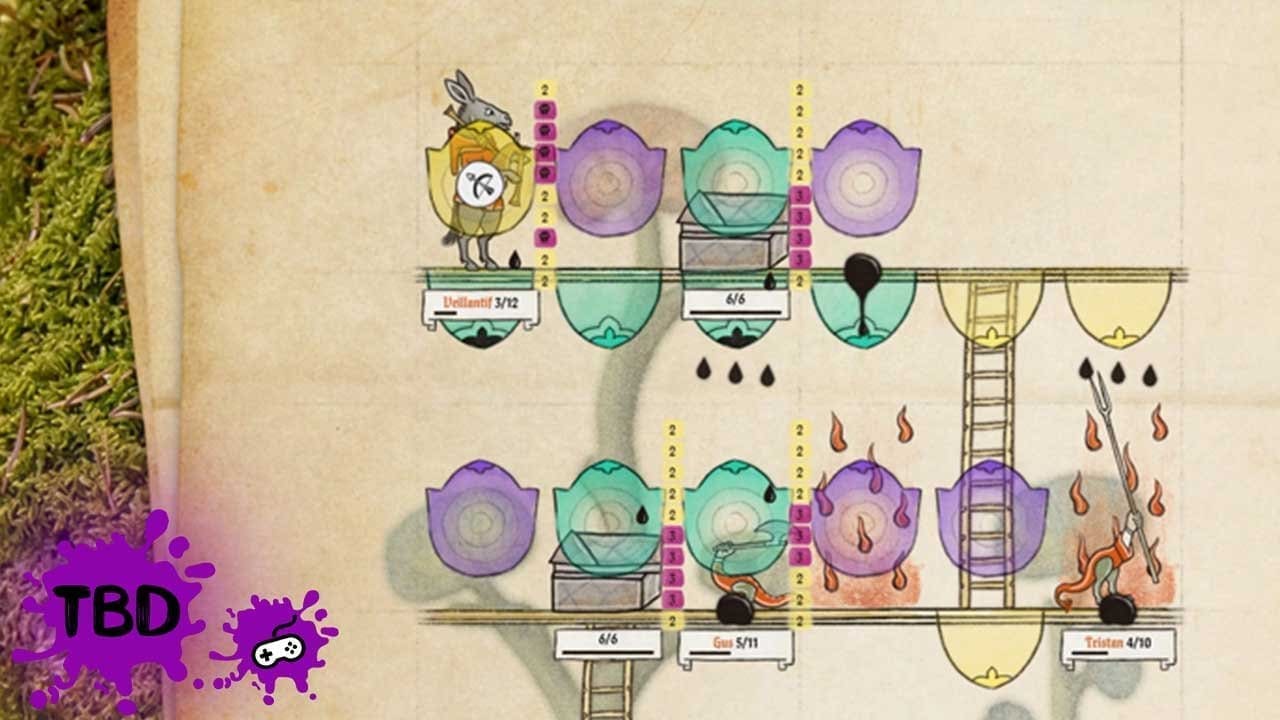
The very first note I took in my playtime was that Inkulinati seemed interesting on a mechanical level, which remained true throughout my time with the game. At its core, Inkulinati is a turn-based tactical roguelike in which the arena is two-dimensional, with different levels that can come into play. This simplicity makes it very approachable and had me picking it up quite quickly (or at least I thought I had). But the game’s tactical decisions are genuinely interesting, and there is a lot to consider at each decision. I found that purely dealing damage was not always the most optimal play, because unit placement on the field could play a big role in how the AI could respond and devastate me during its turn if I had not thought about it deeply enough. Being close to an edge of any ledge could quickly turn south if you forget how fast an enemy minion could be upon you to simply push you over the edge to instant death.

In its current iteration, there are two different kinds of battles that you can encounter throughout your run. The first is an Inkulinati vs Beast Battle, in which you (the (Big) Inkulinati) are represented by an avatar, the Tiny Inkulinati. In this battle, you must collect ink to consistently summon minions (you choose up to 5 before battle) to take out the enemies on the parchment. The Tiny Inkulinati also acts as a King Piece; their survival is critical to victory. Outside of summoning minions, the Tiny Inkulinati can also interact with the battlefield through a number of powers, which can be unlocked or earned throughout the run. The other form of battle encounter is a Beast Duel, in which you choose five minions from your army stack that start the meeting on the board and must instead defeat the enemy’s five minions without the need to protect the Tiny Inkulinati and with no opportunity to gain reinforcements. These slight variances are great and keep the relatively small number of encounters in a run very fresh. You also have boss battles and signposted encounters that offer greater difficulty and greater rewards.

The difficulty in Inkulinati is something that is done well but may be different from everyone’s taste. Even on the easier difficulties, Inkulinati is not afraid to punish a bad decision, which can erase your run in a split second. However, this is balanced by the Quills — which are essentially lives available to you in a run — allowing for a couple of mistakes before you are sent packing back to the main menu. Inkulinati also pushes encounters to be ended before they drag on too much through Apocalyptic Fire which will spread from the edges and force you to end the encounter before it engulfs everything.
Additionally, Inkulinati serves up some interesting unit variety for you to draw into existence. At first, it is simple, with Dogs, Rabbits and Foxes being the main beast forms, each with an Archer, Spearman and Swordsman class. Soon enough, you can unlock Demons or simply ‘creatures’, headless abominations that wield their weapons. The game also encourages you to independently mix up your army composition, as the more you summon a particular minion, the more it will cost in subsequent battles until it has been rested. This leads you to try some of the more exciting tactics and minions, like the slow-moving Snail that shoots anything that dares get in its path or the Donkey Bard that farts into his horn to stun enemies around him.
The Donkey is a hint of the boyish charm of the game, which embraces its medieval stylings in more than just visuals. Despite the crude silliness in Inkulinati‘s presentation, it is never done in a distasteful way, always done in a way that adds a nice levity to the overall experience. This is consistent with the game’s art, which, if not for last year’s Pentiment, would be described as unique in the gaming space. The character designs are given life through their little animations, as you watch a character stumble when slid across the parchment or the way the Donkey giggles as he farts into his horn.
More so than any other game I have reviewed in Early Access, I will continue to play Inkulinati without waiting for further content drops. Its current state is very playable and engaging, with a tactical turn-based roguelike system that gives you endless exciting decisions to make throughout your runs and tactics that cannot be solved because of it. Its personality is also not left behind the tactical combat, and rather it stands with it to make an eccentric experience worth a journey into Early Access.

(Inkulinati code provided for review)