

“Treasure bites back” is the tagline for The Lost Caverns of Ixalan, the latest expansion for Magic: The Gathering. Although this set does contain ancient artifacts like a ‘Mana Crypt’ with a gaping mouth that looks like it could swallow you whole, the expression is used to express the multiple types of ancient beings and creatures, from Ancient Gods to Dinosaurs.
In The Lost Caverns of Ixalan, it’s a race to the planet’s centre in search of a new and rare resource named “cosminum.” As various expeditions head deeper underground on Ixalan, they discover that their world is hollow, with a secret area deep in the centre inhabited by ancient creatures and with a light created by ‘Chimil, a sun.’
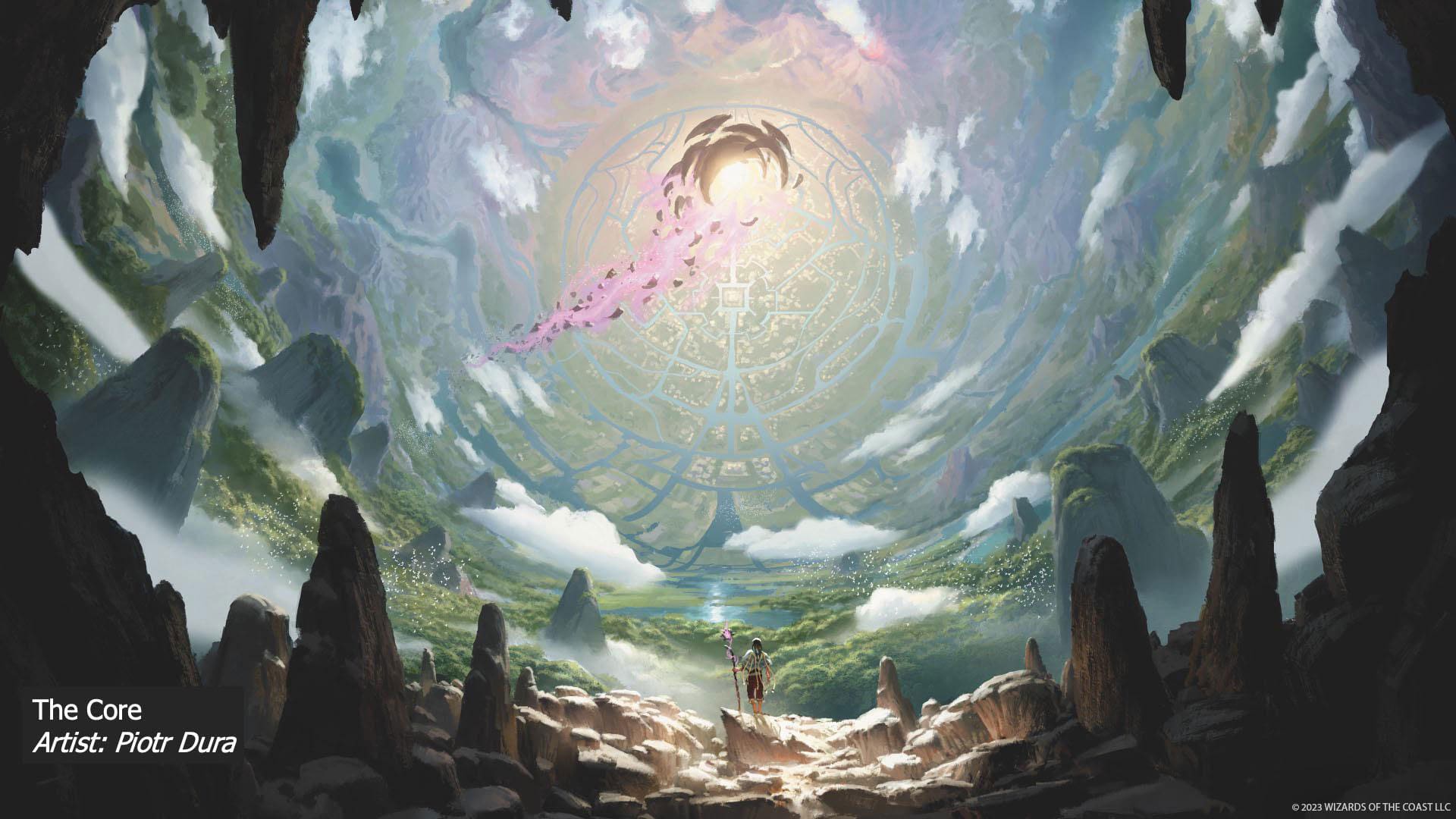
I recently got a chance to submit some questions for the team of Ovidio Cartagena (MTG’s Senior Art Director) and Jules Robins (Lead Game Designer for The Lost Caverns of Ixalan). Read on as I dug for insight into this set’s mechanics, narrative and art direction.
What types of stories influenced The Lost Caverns of Ixalan? Something like Journey to the Centre of the Earth?
Ovidio Cartagena: On the visual inspiration, the Popol Vuh a great motivator. On the world design, the Chilam Balam, Etidorpha, and Journey to the Centre of the Earth influenced a lot of what we created. For the card illustrations, we told each other many stories of our different Latin-American traditions that resulted in awesome works of art (La Llorona, the Tzitzimit, Cascarones, among others).
The Popol Vuh is an ancient Mayan document that historians believe was written between 1554 and 1558. It’s the story of creation and a battle over lords of the underworld—a fitting inspiration for the core of The Lost Caverns of Ixalan. I love the communal gathering and storytelling of different Latin-American traditions being at the centre of the set’s art direction. You can see this on the cards themselves, with Latin-American culture being such a rich source of inspiration for The Lost Caverns of Ixalan.
But let’s look at how we play with the cards themselves: the “Craft” ability is fascinating as it enables you to combine cards, even some in your graveyard, into more powerful ones. But these are double-faced cards, which could be confusing to balance for players and make it work. Was this something the team struggled with balancing in the testing and design phase?
Jules Robins: It certainly was. Crafting has a lot of inherent strength in giving players what is essentially a second card to use later in the game. That made it difficult to balance the front sides of the cards to do enough when you play them while still leaving room for the crafting quest to be worthwhile, all without making the card, as a whole, overpowered. We had an extra challenge balancing the difficulty of finding the appropriate crafting materials. A lot of factors influence the challenge beyond just how many cards match the condition: How easy are those cards to include in decks along with the crafting card? How easy are they to get into the graveyard? How big a cost is it to exile them from the battlefield? How many cards can players mill or put into the graveyard while exploring to find more materials for crafting? We went through a lot of iterations to figure out what sorts of crafting cards to make.
And you feel that testing in every limited game you play of The Lost Caverns of Ixalan. A set built around matching cards to enable flip abilities will always sound like a struggle on paper for limited formats, but it’s been such an exciting and oddly freeing set to draft without a feeling of needing to focus on finding specific cards or having a completely useless deck.
The new “Discover” keyword is very similar to some other popular and, at times, overpowered abilities in MTG’s past, like ‘Cascade. What was the discussion around introducing a new ability that lets you play around the top of your deck and cast cards for free?
Jules: Discover was certainly contentious, and comparisons to Cascade were front-of-mind for us. That mechanic’s had a fraught history in competitive play, mostly in decks with no low mana value spells except for one of the Suspend cards with no mana cost, which they’ll Cascade into every time. Despite that fail case, we’ve found the fairer uses with uncertain outcomes to be fun for tons of players. We tried variations of this space that were harder to cheat but found they either lost a lot of the visceral thrill of flipping up cards one-by-one or got way too complicated. Ultimately, we decided the fun was worth the risk, but we’d mitigate risk where we could: we made cheat-y deckbuilding a bigger ask than it has been with 3-mana Cascade cards by not making any Discover 2 cards. We also moved away from Cascade’s cast trigger, both allowing discover cards to be counterspelled and enabling us to put strength in places that are more often stronger for fair uses like discovering repeatedly or in specific situations. We also found space to make the fair usages more fun, both by introducing other ways to Discover than just casting a spell and by reducing the anti-synergy with situational cards like countermagic and pump spells by allowing a player to put the discovered card into their hand.
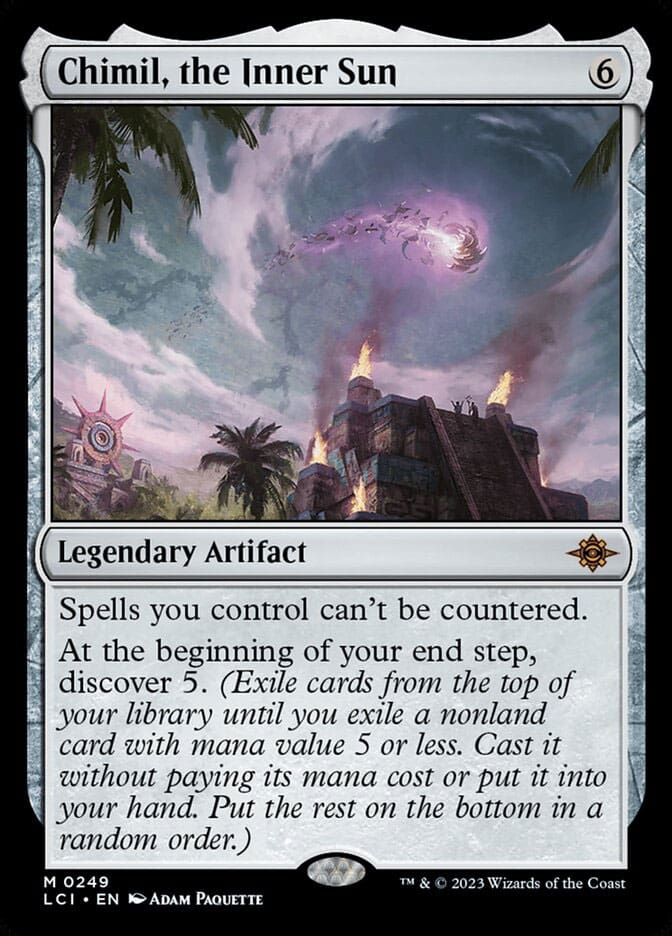
“We decided the fun was worth the risk” may be my favourite quote from the answers I’ve got today. As important as balancing MTG is for both a fun and competitive game, the feeling of throwing all other-thinking to the wind to bring the game back down to being about what’s most fun is something I can get behind. Discover and Cascade also have that one key distinction that I think has made all the difference for not breaking the game: if you counter the Discover spell, its ability doesn’t trigger.
And EXPLORE IS BACK?! Who pitched that?
Jules: When we began design on this set, we thought we’d be taking an underground adventure on a new world. Only after months of work did we conclude that the adventure would be more fun on a world we knew, and Ixalan was the prime candidate. At that point, we took stock of what elements from the original Ixalan made sense to reprise or to leave out, and Explore was an immediate home run, both fitting the setting perfectly and having some of the most fun gameplay of the original block’s mechanics. Andrew Brown (Play Design Technical Lead) was Explore’s fiercest proponent because he was so excited for its potential to make fun, straightforward cards in shapes that play well in 1v1 Constructed decks like Jadelight Spelunker and Cenote Scout.


When I first got heavy into MTG, there was a local player who was older than me and often attempted to give me helpful advice for cards. His advice basically boiled down to playing cards with the least amount of variables, and as such, he didn’t love mechanics like Explore, though he could see the appeal. I, however, love mechanics like ‘Explore,’ where there’s a chance for a blowout or a massive creature to come out of one mana, like with cards like ‘Cenote Scount.’

There’s a new type of ultra-rare alt-art card to look out for in The Lost Verns of Ixalan in the form of ‘Cosmium Neon Ink’ cards, which see reprints of Cavern of Souls looking insane. What was the design decision behind making these cards?
Ovidio: Early in the creative process, I had a meeting with Tom Jenkot, who runs the collectability art team, to look at the concept art and all the ideas we were working with at the time. The idea of glowing cosmium lines across the caves, and especially how colourful the set was, influenced Tom’s team with their ideas. They did an amazing job expanding the authenticity of the set and the colourful art I wanted to bring to it.
There are nearly 40 Jurassic World cards to be found inside Collectors Boosters, each featuring a particular scene from either the Jurassic Park or Jurassic World films. There’s Alan Grant frozen in the face of a T-Rex, Blue coming to rescue Grady, and even the classic face of Ian Malcolm lost in thought.


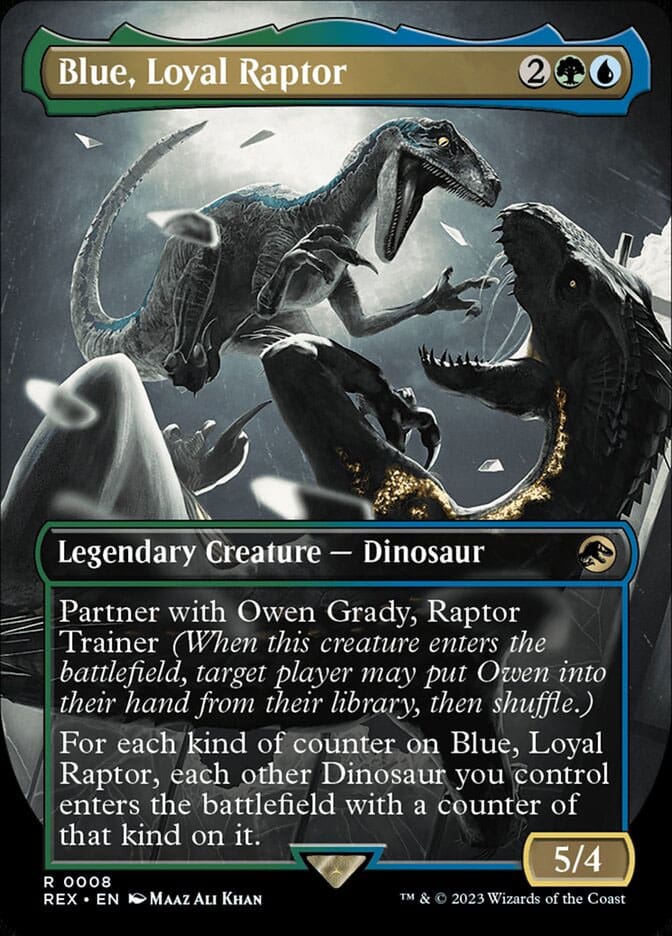

Was there a scene from a Jurassic Park movie that couldn’t make the cut to include in a card but you’d love to have seen?
Ovidio: The sneezing brachiosaurus!!
And finally, what is the best dinosaur?
Ovidio: My favourite dinosaur in the set didn’t get its own card; it was Wayta’s pet dinosaur depicted in a couple of artworks by the great Magali Villeneuve and Fesbra. The dinosaur was designed by Ryan Pancoast.
As for my favourite dinosaurs from real life, we got to include some of the coolest species: Archaeopteryx, Therizinosaurus and even the Borealopelta!
Jules: This quandary has plagued paleontologists and park-keepers alike for eons, but at last, with The Lost Caverns of Ixalan, we have a shot at settling the matter. Many contend the best dinosaur is Bonehoard Dracosaur: not only does it bury your opponents beneath a pile of cards, treasures, and more dinosaurs, but it may be the ancestor of modern dragons as we know them. Another faction contends that the best dinosaur must be from the films that brought them to centre stage: Jurassic Park and Jurassic World. Indominus Rex, Alpha’s name, tells us it’s number one, and it can do just about anything! A third faction tells us that human ingenuity is more than a match for nature and that the best dinosaur is Saheeli’s magnificent Mastercraft Raptor. There’s no limit to its power! But after extensive debate, research, and consultation with the Echoes of Ixalan’s wisest elders, we’ve determined that all these answers are wrong. The best dinosaur is this little guy: Itzquinth, Firstborn of Gishath.
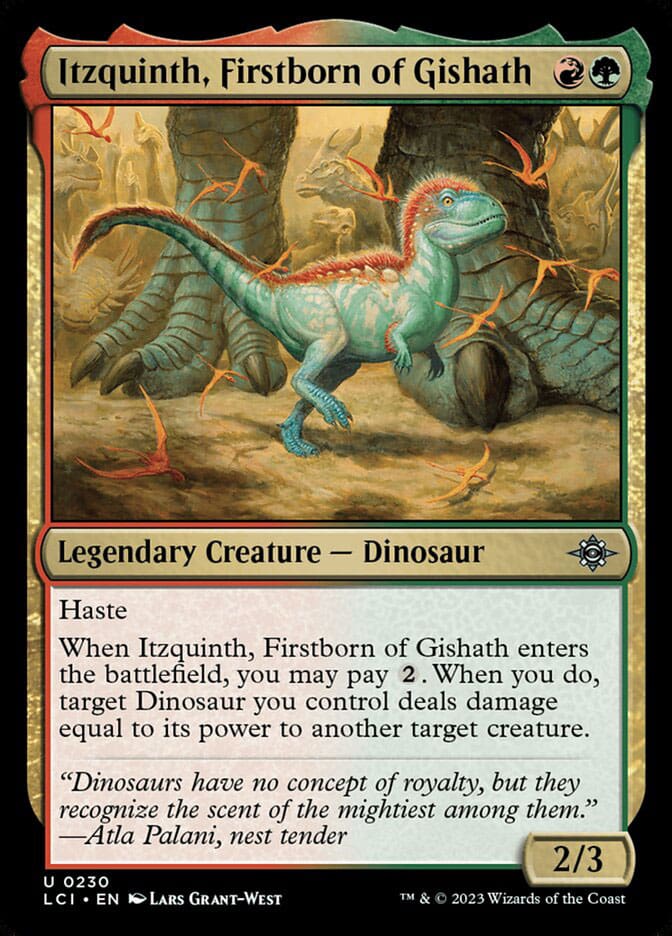
I’d vote ‘Itzqunith, Firstborn of Gishath’ as a total cutie.
Thank you to Ovidio Cartagena and Jules Robins for taking time out of their day to answer some questions about The Lost Caverns of Ixalan and attempting to answer hard-hitting subjects like “What is the best dinosaur?”
You can now find Magic: The Gathering – The Lost Caverns of Ixalan in all gaming stores. Find your local store here. If you’d like to play online, check out Magic The Gathering Arena.