
Star Trek: Voyager – Across the Unknown Review
Star Trek: Voyager - Across the Unknown is a story-driven survival strategy game where the fate of the iconic starship lies in your hands. Take command, manage the ship and its resources, and make difficult decisions. Will you be able to bring the ship and its crew safely home?


The game’s musical score feels reminiscent of the Star Trek shows, with a rich, engaging melody
As a long-time Star Trek fan, I was keen to sink my teeth into the latest of their offerings. Most of my knowledge of the Star Trek universe comes from both the original series and The Next Generation. I only dabbled in the other series in small quantities. I do, however, have a fondness for the universe. This game focuses on the adventures of the starship Voyager, its Captain, Kathryn Janeway and her crew.
I enjoyed playing this game, especially since I didn’t have much prior experience with the series. The multiple choices and actions made it feel like my decisions were truly my own, without the pressure to play exactly as the captain would.
The story begins with the ship being abducted, leaving the crew and the captain unsure of their whereabouts or what had happened. Soon, they discover they have ended up in a completely different sector on the far edge of the galaxy. Nearby, they find a space station. With some exploration and investigation, the crew begins to navigate the station, but before long, two members of the away team go missing. As with many galactic adventures, it falls to the crew and the captain to uncover what has happened and find a solution.
In this game, I experience stories that present me with a variety of choices, and these choices have a meaningful impact on the overarching narrative. I’ve noticed that some of my early decisions didn’t reveal their consequences until much later in the story. The narrative unfolds in brief scenes filled with text, usually giving me two or three options to choose from. While there is some voice acting, it’s limited. Still, I was excited to see that they brought back some of the original cast to reprise their roles.
I also have a range of tasks to manage in the game, such as maintaining the ship, managing morale and food supplies, exploring, and completing missions. As a survival-strategy game, I find these tasks quite challenging.
Maintaining the ship is a critical process. The ship drains power at a steady rate, and this rate increases as more rooms and additional operations are added. It is essential to find a balance, and I must admit that I struggled with this. I often faced challenges in keeping the ship running and completing missions without losing morale or crew members. However, with upgrades to the ship, storage, technology, and other resources, I was able to prevent my ship and crew from falling. Unfortunately, I did lose many crew members when morale dipped.
Combat in the universe is minimal, as waging war is not one of Starfleet’s mandates. However, the Voyager is equipped to defend itself and others when necessary. Combat is conducted through a mini-game in which three crew members are assigned, each with unique abilities. These abilities can include evasive manoeuvres, increasing shield strength, manipulating the enemy’s shields, and more. This tactical combat style is engaging and provides a fun way to diversify the gameplay experience.
Exploration is a key mandate of Starfleet, as they seek to explore and learn more about the universe. However, much of this can only be accomplished outside the safety of the ship. Exploration is carried out in two main ways.
The first involves moving between star systems, where the ship can scan individual planets, asteroid fields, or derelict ships. Scanning provides information about available resources, and getting closer to these objects allows the ship to capture them. This process relies on background systems that determine the level of difficulty. I was then faced with a decision on how to proceed: I could send a shuttle with an eighty per cent chance of success, dispatch an away team, or use a tractor beam. The higher the success rate, the better the rewards. If the ship does not have enough storage, some of the resources will be lost; if the mission fails, all rewards will be forfeited.
The second method of exploration involves sending an away team, typically comprising three crew members. These missions are usually linked to main or side quests. The selection process for the away team is detailed, as the crews have statistical data showing their strengths in science, security, and diplomacy. Depending on the circumstances, these stats play a significant role in determining the away team’s success. When presented with a mission, I generally had three options, each corresponding to different skill sets. Choosing the best option sometimes required utilising two members of the away team. If the team’s stats are too low, the likelihood of failure increases. Conversely, if the team’s stats exceed the required level, there is a chance of a critical success, which typically results in better rewards and outcomes for the mission.
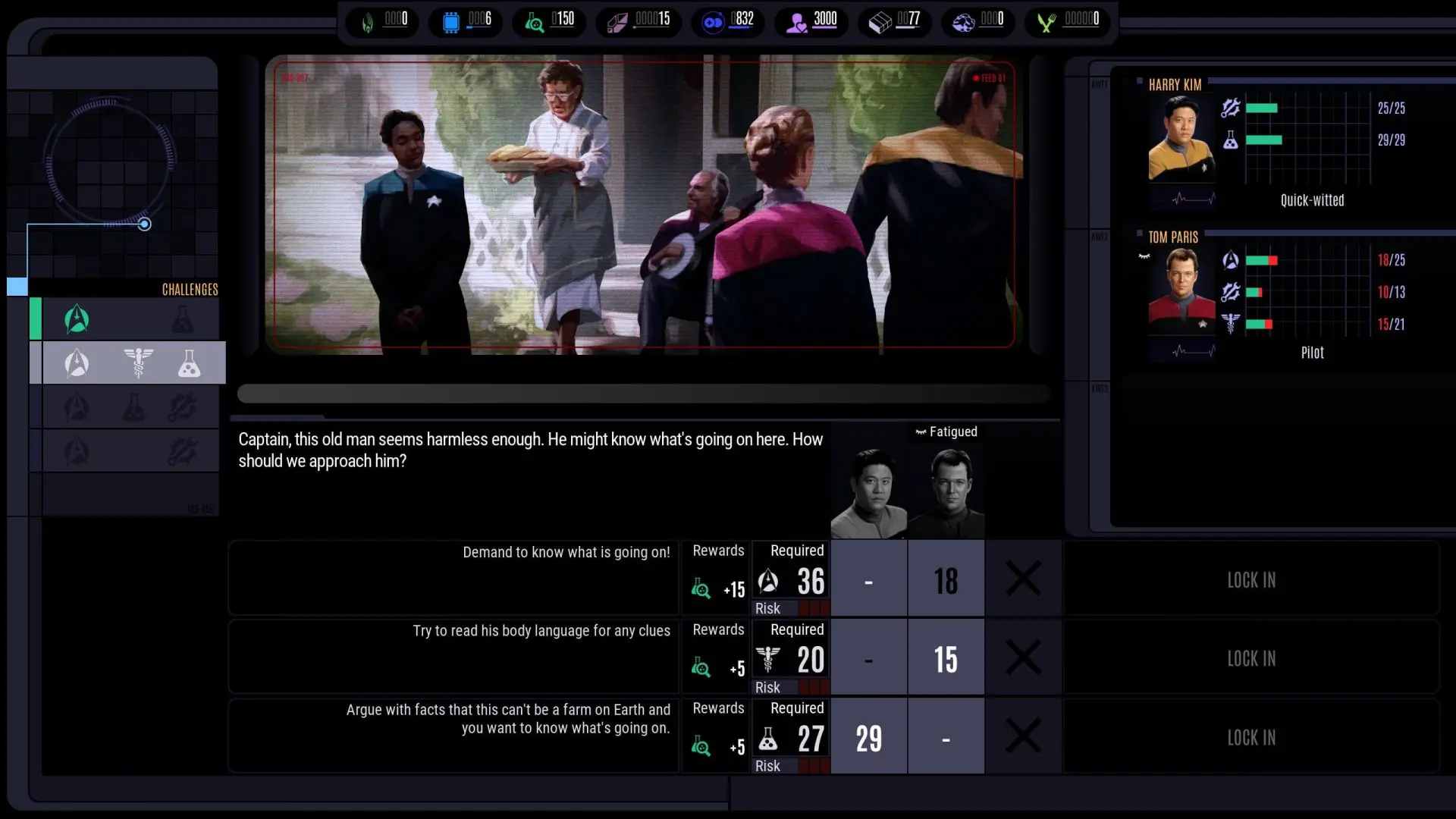
The game’s musical score feels reminiscent of the Star Trek shows, with a rich, engaging melody. The graphics are stunning, but the text is quite small when playing on the Steam Deck, making it a bit challenging for on-the-go gaming. However, the game runs very smoothly on the handheld, which is a definite plus. Additionally, the game includes a wide array of characters from the Star Trek universe.
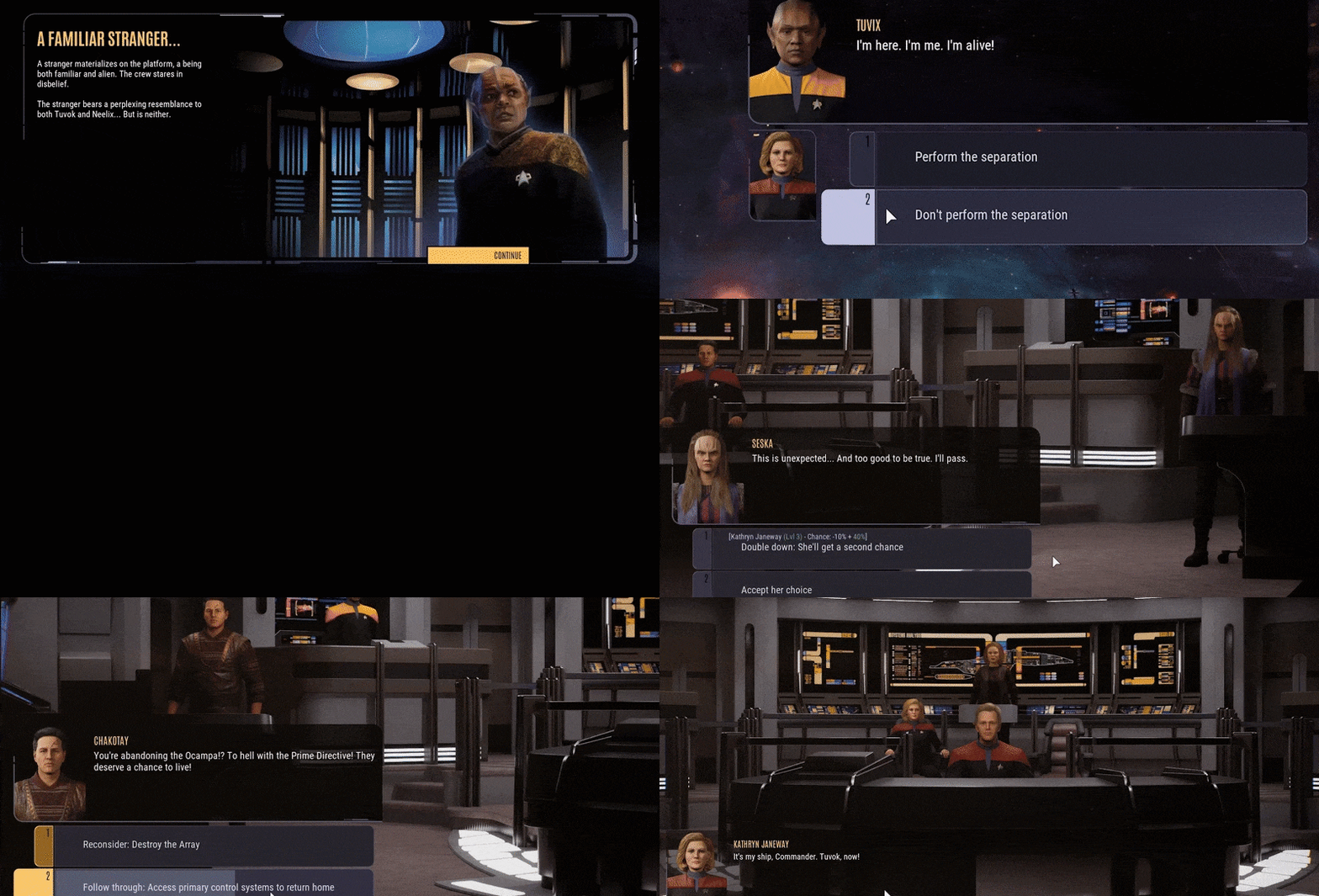
Overall, Star Trek: Voyager offers an engaging experience in the universe, supported by solid mechanics. The game presents rich themes that kept me eager to return, and I believe that even non-fans can find it enjoyable. The music feels authentic to the source material, and the graphics match what I would expect from this type of game. The combat is entertaining and aligns well with the game’s themes without overstepping boundaries. In summary, this title will remain installed as I continue to embark on many journeys into the unknown.
(Review code provided to Explosion Network.
Read about our review and ethics policy here.)
Star Trek: Voyager - Across the Unknown Review
I enjoyed playing this game, especially since I didn't have much prior experience with the series. The multiple choices and actions made it feel like my decisions were truly my own, without the pressure to play exactly as the captain would.

Jacob Hegarty
I enjoy games, and spending time with my pets, I also love drawing, painting, and being creative.
MORE FROM JACOB HEGARTY →

Comments