
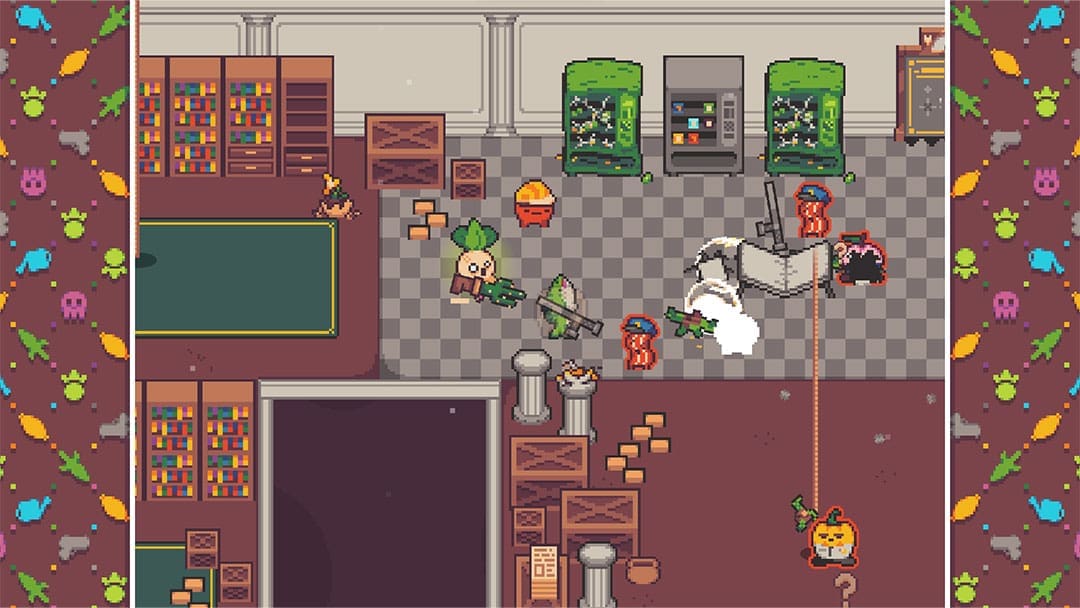
Turnip Boy first committed tax evasion in a game heavily inspired by The Legend of Zelda, and now he’s back to rob a bank and get a change of genre. The adventure is now a fast-paced rogue-lite with guns and intense boss fights. It may be a change of pace that not all fans of the first game will enjoy, but it still has excellent pixel art and odd characters that grab everyone’s attention.
Two days after defeating a god at the end of Turnip Boy Commits Tax Evasion, Turnip Boy is picked up by a pickle gang leader, a friend of his father’s and inducted into the gang. He is now robbing banks. Or, in this case, one particular bank that has the lobby of a bank but proceeds to get weirder the further you manage to explore its halls.

As a rogue-lite, Turnip Boy Robs A Bank is relatively simple. You’ll shoot and slash your way through as many rooms as possible and probably come up against an area you can’t move past without buying some of the Dark Web. You’ll head back to base either by dying and losing half the money you’ve collected or by heading back to the lobby and entering the van. You have a timer every time you begin a run through the bank, and if it reaches zero, more and more guards will begin hounding Turnip Boy, forcing you to make an escape or die.
At base, you can use money to buy stuff off the Dark Web to help you progress in the bank and purchase upgrades to Turnip Boy stats like health, damage, max amount of money he can carry, etc. If you’ve brought back a gun that one of the enemies dropped, you can also trade that in for XP from the gun dealer and permanently unlock more powerful weapons to begin runs with. The choice to trade them in or keep powerful guns is part of the rogue-lite elements of the game. If you die, you’ll lose them. So use them for boss runs, or trade them for XP.
There are four areas of the bank, each with a boss to fight that’ll earn you a keycard to get access to the next area. The fights are based on bullet-hell design rather than the phases and puzzle-like ones seen in the first game. You’ll die a lot, and I certainly did. Sometimes, it was frustrating as I did find the boss fights could have been more exciting and challenging, simply that the game spawned enemies at a ridiculous rate, and often right on top of, or next to, Turnip Boy.
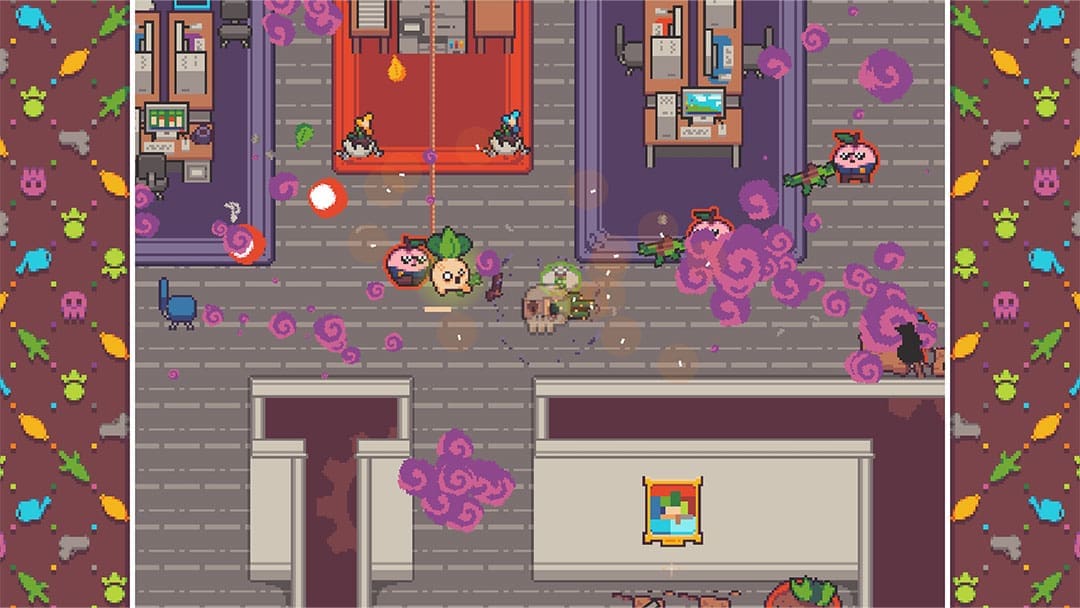
If you’re struggling as I was, a run or two to collect enough cash to upgrade your health and damage should be enough to help you out. You will run into characters while doing this, which are either oddities with weird side quests or they will be parodying something else, which is in line with the first game. The quests don’t reward you with anything to help you beat the game and always give you hats and costume pieces.
The map design within Turnip Boy Robs a Bank is fine on paper. Still, with elevator doors that randomize the location you go to between runs, it makes getting your head around the whole bank impossible and more annoying if you’re trying to complete the side quests. Often, I’d picture where a character was; I’d known which elevator I’d entered to get them the first time, but run after run, the elevator wouldn’t spawn the entrance to that level of the bank anymore.
At around five to six hours to finish, Turnip Boy Robs a Bank is a quick rogue-lite you can see all in an afternoon. Even with the shorter time to beat, I still found it to get too repetitive too quickly, especially for the genre. A passive upgrade tree alongside the one you’re paying for may have helped it feel like you were achieving more. But the runs into the bank quite often begin to feel very similar. There needs to be a random quality that works, not the frustration of finding key characters.
(Review code provided to Explosion Network.
Read about our review and ethics policy here.)